Monday, July 31, 2017

Ka'u Farm School - In Session Again

The Ka'u Farm School was back in session thus week. "Yours truly" was in attendance because I'm always interested in learning some new tidbit about growing food. And yup, I learned a few. 

Stacy & Rachel were there to promote their new endeavor, the Hoveatery. Their next event is this August 11. It's pretty neat to see people making meals using our local foods from small growers. I fully support their efforts! 


Greg, a small local farmer, was there to talk about home food gardens. With the help of other local knowledgable food folks, they gave great demos and info about various gingers..... shampoo ginger and how to harvest the "shampoo"; turmeric; false cardamom (the seeds are used for flavoring and the leaves as wrappers for foods especially fish); galingale (mild edible root and flower). They also encouraged people to grow yacon, pipinola, plukenetia, and moringa. Plus gave us a chance to smell and taste some. 


Also demo'd was some nursery cutting propagation using clean sand rather than a potting mix. Plus seeding greens (lettuce, tatsoi, mizuna, mustard) in potting soil for a cut n come again salad harvest. Greg showed how small farmers make veggie transplants, called plugs, in specially designed trays. Attendees had the opportunity to take some home for their own gardens, 

Raina gave an overview of upcoming programs. The Ka'u Farm School has proven itself more than just a flash in the pan and other organizations are starting to notice. With funding finally being offered, the school can now bring in outside speakers and host further workshops. Wow, it's in its way! 

And finally, before we all stepped up to the potluck buffet, Kyle talked about the local Farmers Union. 

All in all, another very nice presentation for our fledgling school. 

Sunday, July 30, 2017

Sharing Space with Spiders

Found a new one, to me, that is. Found this fellow sitting on a sweet potato leaf. 
 

Working in gardens, yup, you're going to be sharing the space with nature's critters. In fact, I'm the one invading their space, not the other way around. I get along with most critters I find here, though there are a few that I discourage. 

Friday, July 28, 2017

Reject Seed - Using Them

For the past couple of years I've been trying to produce seed for myself. So far I've been focusing upon the bulky seed that usually costs the most to ship here to Hawaii. Beans. Peas. Potatoes. (I'm not yet growing much corn.) 

After a bit of a learning curve, I now have things down pat when it comes to most bean seed, peas, and potatoes. I'm also successful with many herbs and radishes. It's routine now. 

Just recently I harvested quite a bit of bean seed. After sorting through the finished seed, I stored four quart jars in the frig for future plantings. This left me with a bit more than a cupful of rejects -- seeds that were discolored, had dark spots on them, were smaller than others, were misshapened, or had some other defect. Seed companies just throw these away, but I wanted to know what would happen if I planted them. They represent about $7 in seed if I had had to purchase them (of course, assuming that they were good quality). Why throw $7 away? 


Now......I only planned to grow these seeds for cropping, that is, not seed saving. No sense in selecting for plants that might reproduce small or deformed beans. But if I could get edible beans from them or at least plants to feed to the livestock, then I'd be happy. So I went ahead and planted some. 


Except for a few misses, the beans germinated fine. So far the plants look normal. So it looks like I'll get an edible crop out of them. 

Another use for reject seed would be to plant them in the pastures. Nothing lost by opening up a shallow trench, plopping in seed, covering it up. When it germinates, the livestock will find a treat on their next pasture rotation. I feel it's a better use of the seed than to simply chuck them into the newest compost pile. 

Just another example of zero waste and utilizing one's resources on hand. 

Thursday, July 27, 2017

Taro Propagation - Via Corm Buds

Cleaning out one of the bean growing beds, look what I uncovered.......some lost taro corms. 


As soon as I spied them I recalled that I had rested some freshly harvested taro atop the cut log edging, and apparently forgot about it since the bean plants, at the time, covered them over. 


They're beyond eating now, but they present a great example of another way to propagate taro. The corms have dormant eyes in them, and under normal conditions, they never grow to fruition because you cook and eat the corm. But in this case, the abandoned corms slowly began to awaken. The eyes near the soil came to life and set out shoots and roots. 


By carefully cutting the corm into chunks, I can now plant each of these shoots and they will grow into a nice taro plant. This is not the usual way that I propagate taro, but it's a very useful method to use under special circumstances. 


Just recently I had one of those special circumstances come along. I had a new taro variety, called Nuie Ula'ula, that has been growing for awhile. Then all of a sudden I noticed that the top had rotted off. Geez. I lost a variety that I had made a trip over to Maui to acquire. Sad. 

I dug up the  base of the plant in hopes of finding an oha (baby offshoot)......

I was in luck. Five of the dormant buds were sprouting in the corm. I removed the rotted part of the corm, and by replanting the corm on its side, I will be able to get new plants. So all it not lost afterall. With a little time, I will end up saving this variety in my garden collection. 


Wednesday, July 26, 2017

Manure Clean Up

One of the reasons for keeping large livestock is for their valuable manure. Both the sheep/goat and donkey manure gets used in the garden as fertilizer, with much of it being processed via composting. But how does it get from the pasture? 

I don't maintain very many large animals, currently just a small flock of sheep (10), one donkey, and 6 goats. While they have access to several areas, they tend to spend much of their time in one area. It's a favorite lounging and sleeping area, thus also a popular pooping spot. That makes gathering the manure a tad easier for me.

So, the poop has to be gathered in some fashion. While there are manure forks sized for horses, the tines are a tad far apart for picking up smaller donkey "balls". And forget using a fork in sheep & goat manure, they tend to pass nuggets the size of raisins. 

So, what to do? Hand pick up? That's backbreaking and slow. So I opt to use a pooper scooper, like what's made for dogs. But since they aren't available locally, I have my own version. 


Ace Hardware sells a brush rake in the gardening section and a dust pan on a stick in the household area. Put the two together and I have a pasture pooper scooper. No bending over. The rake gets the little nuggets. The dust pan holds just the right amount without getting to heavy. 

While I could use a five gallon bucket to hold the manure, I opt to use old feed sacks. They work fine for me. Plus they are easy to drag behind me as I clean up. No heavy bucket to carry. 

Tuesday, July 25, 2017

Calf Branding

Last weekend I had the opportunity to attend a local calf branding event. This was a "first" for me. Oh, I've worked around cattle before, mostly dairy cows. But I've never seen branding and working the calves. 

I arrived at the ranch at 9 a.m.  The herd had already been brought in from the pastures and the calves separated out. Pictured below, a modern day Hawaiian cowgirl rests, waiting for the next step. Behind her is the pen with the anxious moms. Yes, cowboys still exist here, for real! 


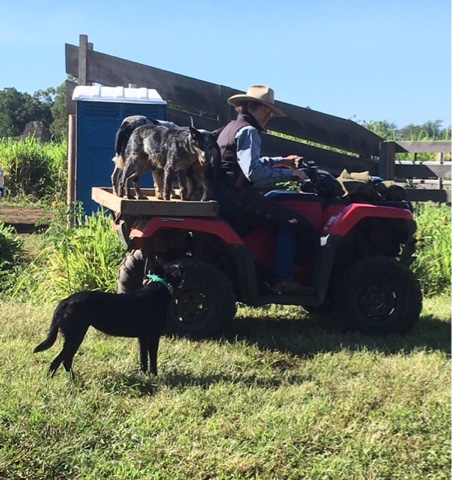
The farm dogs have done their job and are taken away from the area. Those canines love to work, so keeping them in work area would only frustrate them. So they go home to rest. 


The calves are in a pen, of course separated from their moms. I was surprised to see how quickly they calmed down. Very little bawling was heard, just the occasional call to mom. On average, a little less than 10% of the calves would call out occasionally, hoping to find mom. Surprisingly, most were really calm. Not what I expected, but I was pleased to see how gently the calves were being handled. 


The work corral is specifically set up for this action. Small groups of calves can easily and calmly be moved from the main pen to a smaller catch pen. Everything gets set up in advance before the first calf is roped. 


By roping a calf, I mean gently noosing the hind legs. No dashing about on a horse, no throwing a noose over the head, no yanking a calf by the neck, no excitement, no hot-dogging. Everything is very low key. In fact, none of the calves seem very nervous until it's down to the last two. The last two finally notice that everybody else has disappeared and they are reluctant to step into the noose. Usually at this point the calves are caught by placing a noose over their head and shoulders and allowing them to walk through the noose, then closing the noose about the hind legs. Again, very low key and no excitement. 


Once roped, the calves are slowly dragged out of the group pen and to one of the work stations. I was quite surprised to see that most of the calves had no objection. Since nobody was acting excited, most of the calves stayed calm too. 


Once at a work station, the calves were positioned onto their right sides. The horse kept tension on the rope, holding the hind legs still. A cowboy sat on the calf to hold it steady and calm it. Some calves attempted to stand and threw the cowboy off, but others opted to lay still. So far, so good. 


Now came the part that the calves voiced an objection. Frankly, I would too! A hot branding iron was held to the spot on the leg for two seconds. The calf was vaccinated and an ear tag attached. And if the calf was male, it was quickly castrated. Everything was done quickly and efficiently. The calf was released in the matter of a couple of minutes. 


Once released, most of the calves made their way over to the corner of the pen near the exit gate, which was close the the waiting moms. A few simply walked around, visiting the work stations and watching the next calf being worked on. Wow, they didn't seem spooked at all. In fact, cowboys had to shoo these curious calves away from the work area so that they wouldn't be under foot. 


The calf below, sporting it's fresh brand, wanted to return to the catch pen. Eventually someone came by to urge it to join the other calves already done. 


The whole affair was done according to a prearranged pace. 30-40 calves were done, then everyone took a brief break while the finished calves were returned to their waiting moms. Below, a couple of cowboys taking a watermelon break. 


I had anticipated a branding event to be rowdy, upsetting, with lots of bawling calves. In actuality, it was a calm, low key event with very little bawling except from calves actually being branded. Once released, those calves stopped bawling. Some limped for 2-3 minutes (yes, I timed it) while others didn't limp at all. Within 3-4 minutes the calves acted fairly normal, awaiting the gate to be opened so that they could go join their moms. The cowboys waited to open the gate until all the calves in a group were not only done, but also calm and recovered. They watched them for several minutes before returning them to the herd. 

The whole event was run smoothly, and I again emphasize, calmly. The only glitch I saw was when two calves, at different times, broke away from their restraints. But again, no cowboy style hot-dogging. The calves were allowed to join up with other calves and calm down. Then a horse & rider slowly entered the group of calves, noosing the errant calf and taking it to the nearest work station. 

Bravo!!!!!!!! A job well done. At the end, all the calves were returned to the herd and given time to hook up with their moms. Once most of the calves had sorted things out, the herd was released back into the pastures. You would have thought that these cattle would have high tailed it as far away as possible. But no. They hung around. The Cowboys actually had to push them away from the work corral and urge them back to the grazing area. 

344 calves were done, equipment packed away, and horses tended, all before lunchtime. There were some 60-70 people who worked together to get this job done, all volunteers, some coming from other ranches up to a 3 hour drive away. Their reward? In the future, other ranchers will come to help them with their own branding events. Plus at lunchtime the host ranch presented a great lunch (roast beef and plenty of side dishes & desserts), plus a fun raffle of numerous cowboy oriented items. I could see that these people all knew one another, worked well together, and enjoyed one another's company. 

What a wonderful experience.....as long as I'm not the calf, that is. 

So before someone asks, why brand them instead of using just an ear tag? The terrain on an Hawaiian ranch is rough. Thus ear tags can get ripped off and lost. So if the cow breaks through the fencing and leaves the ranch, its ownership can be determined by its brand. Ok you say, why not use a microchip? A microchip isn't visible. One needs to use a scanner, handheld, to read the chip. Ever try to get near enough to a beef cow on pasture to try to read a microchip with a small handheld device? I don't want to try that, but if you're game, just let somebody know where your health insurance card and notorized will are before you give it a try. Oh you say, just get better fences. Really? I haven't seen a fence yet that can keep in 100% of all cows. No rancher wants its cattle to get out, but in real life, it sometimes happens. Thus cattle need easy to see identification. A brand does that. 


Monday, July 24, 2017

First Pineapple of the Season

Yup, it's pineapple time again! 


Last Thursday I picked the first one. This week there are a couple more ready. So far it's the white ones that are coming ripe. I do have a few of the gold type, but truthfully I forgot to mark the plants so I'm no longer sure which ones they are. Perhaps this year I'll remember to tag them. 

White? Yes. Hawaii grows a white fleshed (actually very pale goldish) that is sweeter and much less acidic than the gold types. But it's also not a good shipping type, so it's just available locally. Just about everyone in my area grows the whites instead of the golds. 

If you ever make it to Hawaii, you really need to try a white pineapple that was ripened on the plant. Heaven! Grill it, and it's even sweeter.