Showing posts with label Gourds. Show all posts

Friday, August 12, 2016

Gourd Flowers (this post contained a goof)

"P" asked, "If you are hand pollinating, where do you get the pollen from?" 

The pollen comes from the male flowers, which in this case are on the same plant because I only have one gourd plant. Different vegetables have different flower set ups. In the case of gourds, the plant produces separate male and female flowers. The plant starts out producing lots of male flowers, which actually confuses new gardeners. The think that something is wrong because they see lots of flowers and no fruits.  But it's the way gourds work...males first, females later. After a while the plant sends off lateral vines (side shoots) which will produce the female flowers. Thus the reason why pruning one's gourd vine to a single stem is not a good idea! 

Above, this is a male flower. Notice how the blossom is supported right on the stem? Below is a female flower. Instead of the straight narrow stem, the blossom sits atop a round miniature fruit. 

I always find lots of male flowers, but only a few females. With a little experience, the females are easy to spot. 
**********************************
PS-  "S" emailed me let me know that I goofed. The above flowers are those of the Golden Hubbard squash, not the gourd. Gourd flowers are white. Yup, I goofed. but the flower structure is similar in shape and male vs female. 

Here's a female gourd flower......

And the male......


Thursday, August 11, 2016

Gourd Seeds

"J" emailed to ask, "What do the seeds look like?" So here's the seeds that I saved from the gourd.....


Yes, they all come out of that one gourd. That's quite a lot of seeds. I'm estimating that there's about 400. I plan to dry them, save a few for myself, sell a few, and give the rest away. Since I have several more gourds on the vine, there will be plenty of seeds to go around. 

This gourd plant is the only one on my farm, in fact, the only one I'm aware of anywhere near me. So I'm assuming it's most likely been pollinated with itself. That fact should help make the next generation similar to the parent. But since I don't know the parentage of the mother plant, there's no guarantee. Yes, the mother plant is a volunteer that just showed up here out of the blue.  

Wednesday, August 10, 2016

Gourd - Next Step

Instructions from gourd master artist:
1- use a saw to cut the top off the gourd 
2- watch out because the gourd will vomit all over your shoes

Yikes! Just what I'm looking forward to......stinky, slimy, rotted gourd vomit all over me. Yes, this particular gourd is undergoing internal putrefication so it's full of really stinky liquid. 

So the first thing I needed to do was get ready. Hacksaw on hand, I first dug a hole to catch all the gourd vomit...

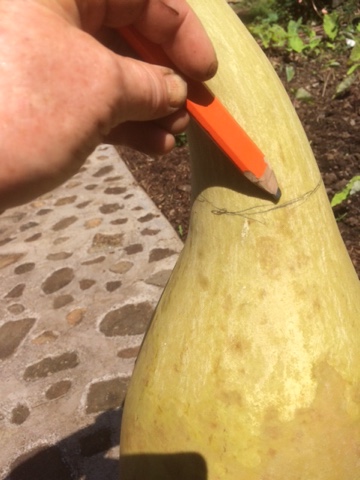
Next I pencilled a line to follow......

Then per instructions from the gourd geru, I made a shallow cut all along the pencil line.....

Then I cast my trepidation aside and began sawing. Instantly gooy jelly oozed out.....(yup, I missed my line, but what the heck)

Pointing the top of the gourd toward the hole I had dug, I sawed the entire top off the gourd. Indeed, the Master was right. Gourd vomit gushed out! This was just the start. When the gourd was tipped up, it seemed like a mountain of jelly infused liquid poured out, filling my hole. Stinky! Thankfully I don't have much of a sense of smell. 

Looking down inside the gourd I saw that there was still a lot of jelly adhering to the sides and bottom. With the gourd's hole too small for my hand, and the gourd too long for a long handled spoon, I opted for a long stick to scrape the jelly out. Once I loosened a chunk, I'd flush it out using a hose.....

I scraped and flushed until I didn't seem to be getting anymore out. But visual inspection showed that the gourd wasn't whistle clean yet. The next set of instructions from the Master said to put numerous small, rough, roundish rocks inside then swish, rotate, jiggle, and dance the rumba (no, she didn't really say to dance though she did suggest playing music to shake by). I was instructed to do that until the rinse water ran clear and the inside of the gourd smelled nicely of wet swede leather. Good gosh, with little sense of smell, that was going to be a challenge. But after much shaking, I think I got it. 

Final step......put gourd in a warm airy spot in the sun to dry. Easier said than done. My house doesn't host a spot meeting those criteria. Things don't dry out well where I am. So I'll be taking the gourd to the seed farm to sit for a spell. 


Tuesday, August 9, 2016

Gourd Experiment

Bear with me on this one. I haven't the foggiest idea what I'm doing and where it will lead. I've got this giant gourd that has been growing over by the rabbit pens. One of the community garden volunteers found it this morning. The gourd is already mature, and due to the constant wet, was starting to rot on its skin. But what a beauty this gourd is! What potential! I'd like to see if I can do something with it. 

Our local gourd artist told be that this gourd variety is usually has a thin shell, thus its not a high quality art gourd. That's fine with me. I'd feel bad if I destroyed a good quality gourd, so I'm glad I'll be working on a practice gourd. She also told me that the outer skin needs to be removed prior to staining or wood burning this gourd. I got the impression that gourds are normally dried before one works with them, but being ignorant of "proper gourd technique", I'm going to do some work on this gourd right now. 

Much of the skin on the lower half of the gourd was wet, slimy, slippery, and sloughing off. By rubbing a very, very dull blade over the gourd, the brown skin was easily removed. 

In fact, the brown stuff came off in long ribbons. 

As I worked, I kept rinsing off the loose stuff so that I could see what I missed. 

Once I got a section cleaned of the sloughing, rotting skin, I'd rub it with a pot scrubber to get off any little bits I might have missed. As I rubbed, I flushed it with water. 

I think it was coming along really nicely. Once I got all the brown skin off, I then worked on the lighter colored skin on the upper half of the gourd. This skin hadn't started to rot yet, but it was very easy to scrape off with the dull blade. 

The gourd itself was hard. This skin was soft. Scraping was easy. 

It took me 30 minutes to completely clean the surface. But then, I didn't really know what I was doing or what to expect. I bet I could have completed the whole job in 15 minutes. 

Now what? Time to consult with the gourd artist. 


Friday, September 6, 2013

Slug Buffets - Going Green!

This is great!!!  One of the blog followers came up with this.

I'm a big advocate of using what you have on hand. 

So S.J. wanted to protect her newly seeded radishes from marauding slugs and decided to make a slug buffet. Not having any plastic containers around, she did happen to have an old gourd. Cutting it up into the appropriate shapes, she created a marvelous version of a slug buffet, feeding tray and all. 

I love it!!

Friday, August 30, 2013

Continuing Rat Attack on the Gourds

A large rat-chewed hole in one of the prized gourds. 


The rat that ate the small gourd last week, leaving it looking like an apple core, has moved over to the next trellis. He nibbled on a number of those small round gourds then got to one of the prized large gourds. He ate a hole into the side. Bummer! Bad rat!

Ok, he's got to go. He just ate a potentially $300 gourd. Not acceptable. So out come the big guns. I put some poison pellets inside the hole. I'm sure he'll find them tonight. Normally I would not be using rat poison, but I've had standard traps out in the nearby greenhouse without success. Two days ago I saw that one of the traps was sprung, but no rat. Since then the rat has been avoiding the traps. No droppings near them at all. So he's become trapwise. 

I actually feel bad killing the rat. He's just doing what he does in order to live. Totally natural. But I have to draw the line somewhere, because I too need to live. Actually in this case, a friend of mine depends upon those gourds. It's her livelihood. Losing this gourd is a major blow. 

Hawaii has an over abundance of rats. Cute furry rats. But they spread a nasty disease called leptospirosis. And they ruin our food, water, and supplies.  Plus they have a severe negative impact on native flora. So this rat just has the bad luck of having set up house in the wrong location. 

Boy, I'll be glad when the kittens are old enough to do rat patrol! 


Friday, June 14, 2013

First Gourd of 2013

I drove down to the Mark Twain (arid farm) land to water the plants and had a pleasant discovery. The first baby gourd has set! Wow, I hadn't expected it already, but I'll sure take it.  :)

This gourd is only a few days old, not even a week. So it will get a whole lot bigger. When it reaches its full size I'll take another photo so that you can compare them.

This gourd is a local variety that we call Ka'u Big Butt. Its shape and size makes for very nice bowls.

As you can see in the photo, the ground here is very rocky. There is some soil between the rocks, but on first impression you'd think, "Rocks, nothing but rocks." So it comes as a surprise to some people that things can actually be grown here. Gourds is one of those crops.

This particular gourd will become a practice or training gourd, I suspect. Because I did not discover it soon enough, it has some scarring on one side due to the wind rubbing it against the rocks. But even training gourds have their worth.

In addition, this gourd is valuable for its seed. The plant was the most vigorous and the earliest to set fruit. As long as it proves to be disease resistant, I will be keeping the seed for future planting. Since the only other gourds around are also Ka'u Big Butts, the seed should be true to form.