Saturday, July 11, 2015

House - The Bedroom Project

It's about time that I start working on the house again. It's been too long of a break. Lets see, we've gotten done the livingroom, closing in the lanai to expand the livingroom, the kitchen, the little extra room off the entrance, the foyer, and the hallway that is 95% complete. On the outside we've done the siding and trim, several steps and railings, plus the roof. We're not totally happy with the way the roof turned out, so we plan to make changes later on. But that's a future story. 

Still to be completed is the bedroom, enclosing the bedroom side lanais for large storage closets, and the bathroom. Plus a few other tweaks here and there. 

So we're targeting the bedroom as the next project. Currently it's a quite serviceable bedroom with an unfinished interior. We've already wired outlets and lighting, plus put in two ceiling beams.  Next step.....the ceiling. 

Insulation. We've decided to line the ceiling with foam insulation as a sound deadening measure. Not that we are trying to block out all the sound, but just deaden it a bit. Heavy rains can be quite loud on a metal roof. A side benefit will be to reduce the heat generated by full sun on the roof. 
The styrofoam insulation sheets come 4'x8' and are easily cut to size with a box cutter. By cutting them snug, we don't need to glue or tack them into place. The next step will secure them. 

Next step is to install thin nailers to the corners and running along the rafters. These nailers hold the foam panels in position. 

The reason for the nailers is to have something to nail the cedar ceiling to. Using an air powered nailing gun makes putting up the ceiling pieces reasonably fast and easy. 

Next step will be to sheath over the rafters, like the kitchen ceiling. 
We haven't decided what color to paint them, but it won't be white. I'm thinking....pale sky blue. A possibility. 

Record Heat

A tropical depression is passing north of the islands and it has brought along high humidity and temperatures. In fact this is the hottest I've seen since moving here. 

The low for last night was 69° F. It made for some uncomfortable sleeping. 60° is more common, although this summer so far has been seeing plenty of nights at 62°. It's been the warmest summer in the past 14 years. 

The high today is 88°. I'm sure it's well into the 90's along the coast. And yesterday it was 92° inside my mother's house in Naalehu. Hot. Hot. Hot. Yeah go ahead and chuckle. I'm sure it's hotter where you are, but I purposely chose a location where I wouldn't roast. Up until now I haven't needed air conditioning or even a fan here. Of course I have neither in my home. 

Temperature varies here in relation to your elevation. The coastline is the hottest, and the further one goes up the mountains, the cooler it gets. So if you like it hot, you live down near the coast. But people living at the top of Oceanview or in Volcano find it cold enough to routinely wear long pants and don warm coats when going outside when the sun is down. 

Friday, July 10, 2015

Orchard

Lately there have been several inquiries as to what trees I have in my orchard. Unlike what is taught in permaculture courses, I don't have one spot designated as an orchard area. Concentrating all the trees in one area may make sense in certain situations, but I don't find that to be a good idea on my farm. I'm finding that spreading trees around in order to combat pests and disease is working better for me. Concentrating the trees in one spot means that if a problem crops up, the entire orchard could be affected. Sort of like putting one's eggs all in one basket. 

So what are my orchard plans /goals and what has been accomplished to date? I think I'll go down the list in no particular order. 

Bananas
We eat bananas all they time, so this fruit is high in my list to be home-produced. I currently have several different varieties growing up by the house, along the driveway, down in the "valley", and along the dry defunct riverbed. Since my livestock also enjoy eating this plant, I plan to expand the banana beds. I want to have bananas surroundng the "secret garden" plus more along the far property line. As I get keiki, I plant them. So I'll be at this for a couple of years yet. 
Above, a clump of Cuban variety banana. They can be used as a cooking banana, but we like them ripe as an out-of-hand-eating banana. 

Lemons
Currently I have one variegated lemon in the main orchard plus volunteer trees behind the barn, one beside the pond, and one back by the "secret garden". I use quite a bit of lemons when I have them available. So perhaps I'll add some more and try different varieties. 

Limes
None so far. I'd like to add at least one Tahitian lime and one kefir lime. I currently get plenty of surplus limes from friends, but it would be nice to have some right on the homestead. 

Oranges
In the orchard I presently have one unknown variety that is quite juicy, one sour orange, one tangelo. I'd like to add another tangelo or two. And maybe a juicy tangerine variety.

Grapefruit
One pink tree in the orchard. That's enough. 

Pomelo
None so far but I'd like to add one of the juicier seedless varieties. 

Jackfruit
I have two trees but both are young. So I don't know if they will fruit here. 

Macnuts
6 trees that line my driveway. That's probably enough for personal use, but I wouldn't mind a few more for feeding to the livestock. 

Mulberry
Currently one white fruited tree. I'm planning on adding a purple one soon. 

Apple
Two trees so far. I would consider adding more in the future. 

Miscellaneous
One each of cinnamon, allspice, clove, jaboticaba, tree tomato, mountain apple.
Young allspice tree that I harvest a leaf here, a leaf there. Oh it smells so good! 

Clove tree. 

Papaya
I'm keeping around a dozen trees of producing age. But I intend to add at least a dozen more when I've got space ready for them. In the future I'd like to add several dozen more, perhaps along the street side of the property where they would get good sun. The livestock all love papayas, fruits and leaves. 

Still thinking about adding: 
Avocado .. Lisa and Linda , maybe another variety too.
Malabar chestnut
Sweet bay
Figs
Loquat

Failures
Cocoa. Twice I've failed. Not going to try again. I either don't have the right environment or lack the knowledge, 
Avocado. Accidently killed the tree I had. So I need to replant. 
Mango. I found out that they won't fruit at my homestead location. But I have put in two trees down at the seed farm where they should produce fruit. 
Breadfruit. Wrong environment for them. But I might try one down on the seed farm. 

Many others may grow but I haven't looked into them yet because we aren't currently eating them or I don't know anything about growing them yet. 
Lychee
Longon
Rambutan
Mangosteen
Sapote
Cherimoya
Soursop

Rejected because we didn't like them. 
Surinam cherry.
Abiu. 

Thursday, July 9, 2015

Homesteading for Real Food?

I've recently been getting emails in regard to non-natural chemical use in foods. (By chemicals I'm referring to those that are not naturally put there by Mother Nature.) I have to agree that finding non-altered and chemical free foods in stores is close to impossible. Even most fruits and vegetables have been chemically treated one way or another. My own solution to this is to eat locally produced, non-treated fresh foods....mostly my own. Plus some raised by people that I know. Some foraged. 

I'm currently in Waikiki so I'm eating whatever is available via stores and restaurants. Bananas chemically ripened. Apples treated with fungicides for shipping purposes. Pineapple treated on the farm while growing. Meals in restaurants using processed foods. I'm finding it totally impossible to eat totally "clean & natural" foods. They simply aren't available. 

Out of morbid curiosity, I took time to note today how much actually fake food was around me here. I never thought about it before, so it was quite revealing what has happened to our foods. 
Fake......
.....bacon bits on the salad
.....fake blueberries in the breakfast muffin
.....fake lemonade offered at lunch - the label showed zero lemon juice in it!
....."fake" cranberry juice at breakfast - mostly sugar water
.....fake crab salad on the dinner menu
.....fake ribeye on the plate of a diner sitting at a table beside us. The muscle pattern was all wrong so it had been made by meat cuts put together with meat glue.

And how much stuff was fake or close to fake that I wasn't aware of? Was the chocolate milk really just milk and cocoa? I don't think so. How about the honey? Real or flavored sugar water? Was that slice of cheese on the omelet really cheese, or possibly some stuff sold as processed cheese? Were those eggs fresh or out of a carton? They looked to be out of a carton. Way too uniform in color and texture. 

While I'm not a vegan eater, I know of folks that are. Now you talk about fake food! Take a look at vegan offerings in the stores. Vegan cheese. Vegan bacon. Vegan shrimp. Vegan sausage. And on and on. All fake food with long chemical additive lists. 

One of the side benefits of creating a homestead farm is that I have easy access to "real food". Now that I've moved to eating mostly real foods, I discover that I prefer it. Spending the last couple of days in Waikiki has reaffirmed that. Eating here has made my body object. It's gotten use to real foods. It will be much happier when I return home. And quite frankly, so will I. Visiting "the city" from time to time makes me really appreciate living where I do. 

Saturday, July 4, 2015

Happy 4th July !!!

I love the 4th here. My community celebrates it in a number of ways......picnics, parties, home fireworks, town parade, rodeo, kids inflatable play park, senior bingo, food booths and Saturday farmers market. Lots of home gatherings with music and food. Plus many folks spend the weekend camped down at the beach. All in all, a nice way to spend a holiday.

For the past ten years the town has hosted a parade. Yeah, it's hokey but I love it. And I see that lots of us around here love it too. Over the years it's grown from being a line up of the town tow truck, ambulance, park maintenance crew, and local hauling/dump truck to something that passes as a gosh darn for-real parade. Here's a few pictures of this year's parade........groan if you want but there was clapping, cheering, and approving whistles from the spectators (I'd guess 300-400 people lined the street). Perhaps more because I'm lousy at estimating a crowd.) 

One small section of the spectators, wisely positioned close to the coffee truck. 

Yes, the ONLY road through town shuts down to all traffic. Nobody gets through, locals and tourists alike. We take our parade seriously! 

This year's parade was lead by the rangers from Volcanoes National Park. 

 Our town fire truck. Aahh, tradition. The yellow came from the next town 20 minutes away. 

Bagpiper? Sure, why not. Hey, he was good! 

And if a bagpiper can participate, why not a group of Trojans? Sounds good to me. 

This train comes to all the parades. The kids are fascinated with it. 

The town tow truck never fails to attend, wrecked car and all. Many of us know who owned the wreck. It's a small town, afterall. 

Our own homegrown American Idol contestant performed on the "float". Hey, he sings pretty good. I wish him the best of luck.  

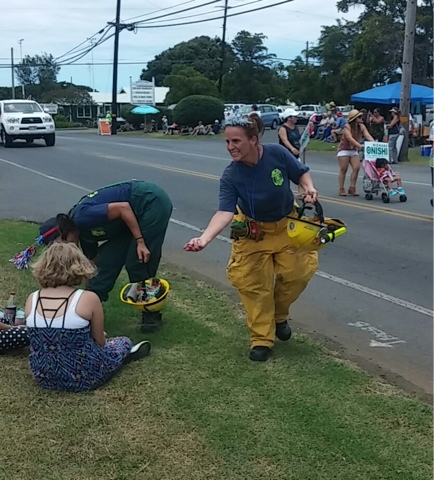
Volunteer firefighters handed out goodies to the children along the parade route. 

Several pa'u riders attended again this year. Everybody cheers them and takes lots of photos. 

Of course we also saw our Ka'u coffee queen and peaberry princess, several local church groups, the girl scouts, several vintage and specialty cars, motorcycles, lots of horses and dogs, the local library group, several of the community interest and help groups, several politicians (of course), .....didn't I say that our parade has grown? Yes, it's the real deal now. 

Staying with our own tradition, we spent the afternoon with friends, skipping the rodeo on the 4th. But Sunday was the second half of the rodeo, which we caught. Lots of fun going on. And lots of good people, beautiful horses, savvy steers.

And one pissed off goat who has to endure little kids (from two years of age and up. Yes, kids start out young in rodeo here) running up behind him to grab the ribbon tied to his tail....called undressing the goat. But this year's goat was rather patient. Perhaps he's been this year's practice goat and has seen this silly stuff before. Last year's goat played catch-me-if-you-can. 

The fun event was the girl-guy team mugging. One rider on horseback ropes a steer, then the other person on foot runs up and grabs said steer to stop it from running. Sounds easy. Then horse rider jumps off horse, runs to steer, removes ribbon from its tail. Rope is then removed from the steer, both people join hands and run back to a barrel in the middle of the arena, bringing the rope and ribbon with them. Simple. Ha. Ready to give it a go? Let's see.....everybody today successfully roped the steer, but some couldn't run up and hand capture the critter and hold it still enough for the partner to help. Dragged through the dirt. Stomped on by the steer. Kicked. Flipped. Stomped on my their partner. Tripped over by their partner....repeatedly! Tangled in the rope. Some got the ribbon but couldn't get the rope off before the steer ran off. Some got dragged right across the arena before finally giving up and letting go of the rope. Steer won. Their clothes would have been great for a laundry soap commercial, ya know, the grounded in dirt ad. These poor people got really, really dirty! And I bet they will be sore tomorrow. And those steers were real savvy, they knew exactly what was going on. As soon as the puny humans gave up, the steers casually trotted in a straight line to the exit gait and calmly waited for it to open before calmly leaving the arena. Some gave playful hops and twisting leaps. 


Friday, July 3, 2015

Onions

We're big eaters of onions, so I grow a lot. Most of what I grow is non-bulbing onions. They grow well here and I can produce them year around. I prefer the bulbing type for much of my cooking style, but I can only get them to bulb in spring and early summer. I haven't figured out yet how to get them to bulb at other times. 

With green onions I can use the entire plant for flavoring. Before moving here I wasn't aware that I could use the green leaves. My mother always threw them away. But I quickly learned about using the greens. 

I pulled some green onions yesterday for a bean dish I was making. I'll be using the entire plant except for the roots. 


The root area I cut off, leaving a bit of the bottom white stem. Why? I will replant them back into the garden. Most will sprout and go on to produce another green onion ready for harvesting far quicker than if I grew it from seed. Replanting the roots is another way to produce onions. Pretty neat trick. 

Rather than pulling out the entire plant when I harvest, I could have just cut it off at the soil surface. In fact, this method works better because all the roots survive and regrow, rather than having some roots die and the rest being shocked into a major setback. But these particular onions that I picked were crowding other onions, so I needed to thin them out anyway. 


Thursday, July 2, 2015

Thimbleberry

We have a rather sticky-ly thorny bush here that grows in patches on my homestead place. I've known it as thimbleberry since moving here. Just recently I had a mainland visitor who informed me that the leaf was quite different from the thimbleberry he was familiar with, so I had to go look it up. And he was right! Turns out that his homeland thimbleberry is a kissin' cousin to mine. His has the scientific name Rufus parviflorus while mine is Rufus rosifolius. The leaf shape is the most apparent difference I first noticed. The Hawaiian thimbleberry leaf looks more like a rose bush. 


Right now the thimbleberries are flowering and creating little red berries the size of raspberries. When ripe, they are red. It's easy to know when they are ripe because they readily come right off the bush and look like little red thimbles. While edible, I find there taste to be insipid. (Hey, how often do you get to use that word!) In plainer words, they're flavorless. But if I wanted, I could surely eat them. The fruit production is sparse, so it would take a massive area of thimbleberry to produce enough fruit to make a cup of jam. But a small handful is do-able and would make a nice decorative statement in salad or atop a cake. 


My rabbits like to eat thimbleberry. They'll eat the entire bush except for the thickest stems, and those they will debark. So I allow thimbleberry to grow so as the be part of my rabbits' diet. 

I find thimbleberry to be an annoyance.......except for the rabbit forage part. It's very thorny. It creates a tangle. It spreads readily via underground shoots. It is difficult to remove by hand and grows back if you leave roots behind. 

For rabbit forage I allow it to grow about 2-3 foot high then snip it off at ground level, using a hand pruning shears  and then cut it into 12-18 inch long lengths.