Sunrise...
Tuesday, December 25, 2018
Monday, December 24, 2018
Totals 2018 -- Final Planting Frenzy
One final push to get things planted this year.....
...1/4 acre of oats for pasture grazing
...10 banana trees
...126 sq ft taro
...14 pineapples
...about 500 onion seedlings
...35 chaya cuttings
...400 sq ft sweet potatoes
...22 pipinola
...10 sugar cane starts
So here are this year's totals:
Single plants :
4 moringa
34 bananas
2 citrus
135 pineapples scattered about the farm
52 pipinola scattered about the farm
500 (about) onion seedlings
35 chaya
10 sugar cane
Sq ft of garden space planted :
699 turmeric
18 yacon
45 potatoes
634 sweet potatoes
30 cholesterol spinach
66 pipinolas
30 chocolate mint
1076 taro
72 peas
305 fresh green beans
396 pineapple
Saturday, December 22, 2018
Homemade Fermented Chicken Feed
This year I'm trying to fine tune my livestock feed. My major focus is on time and energy, meaning that I would like the feed preparation time to be much less, and come up with methods that don't require the use of lots of expensive energy (electricity, propane, gasoline, firewood).
Time is the thing that I'm always short of now. I'd like to become more time efficient....but....I don't want to do it by spending more money. The easiest way to cut down in time is to throw cash at the problem or task. Such as : cook with propane instead of wood, use a tractor or backhoe to get big jobs done instead of hand tools. Yes, I could do that, but I prefer the idea of doing things with small tools. Crazy....yes. Satisfying....Yes!
So I've been toying around with ideas and doing some experimenting. I recently discovered that I could use fermented banana trunk as as pig feed. So I wondered if I could cut down the prep time for the taro that I use for the chickens by fermenting it.
Why ferment taro?
...first of all, the chickens readily eat fermented foods. In fact they eat spoiled garbage with relish. Fresh pumpkins are ignored, but let them rot a bit and the hens greedily gobble them down. That's so nasty watching it that I have to walk away, otherwise I'd gag. Boy am I glad I'm not a chicken!
...fermented feed can be stored for weeks without refrigeration.
...fermenting taro significantly reduces the oxalate crystals, thus eliminating the need to cook the taro.
My original method.....
...chop up the taro and cook it
...send the cooked taro through the blender to mix with chicken mash
Next method.....
...send chopped up taro through the garbage disposal
...cook the ground up taro
...mix it with the slop & glop
Current method.....
...send the chopped up taro through the garbage disposal
...store the ground up taro in sealed air-free 5 gallon buckets
...ferment for 1 to 2 weeks (can be stored for at least a month, maybe more)
...mix uncooked fermented ground taro with the slop & glop
This newest method is working. What's nice is that I can work a taro patch, harvesting the trimmings for feed. Then I'll grind it all up and store it in buckets, giving me anywhere from 1 to 4 weeks worth of fermented taro to add to the chicken feed. So I'm not harvesting and cooking taro every day. Whew, what a relief!
So I've got a good working solution for taro. What about other crops? I looked to pipinola next.
Pipinola can be fed raw or cooked, though they get more out of the cooked stuff. Thus I've been cooking it. But I started wondering if I was really gaining enough nutrition and digestibility benefits to pay for the effort and time of cooking and grinding it. Although I found no statistics for pipinola specifically, I found information on other fermented foods for livestock. Fermenting definitely had its benefits over foods being fed raw. So I gave fermenting pipinola a try.
Just as with the taro, I coarsely chopped the pipinola and sent it through the garbage disposal. The resulting pulp sans the excess liquid was sealed in an airtight 5 gallon bucket. I let it ferment for a week and gave it a peek. Looked and smell just fine. Then I let the chickens and pigs give it a taste test. Yup, they ate it. Ah-ha, two thumbs up! I found a way to process and store the abundant pipinolas so that I wouldn't lose them to rot. The fermented pulp should last for at least a full month in the buckets without refrigeration, maybe longer. I presently have 3 week old fermented pipinola and it still looks and smells fine, and both the chickens and pigs willingly chow it down.
So far, I like this method. It is saving me time, I can process a month's worth at a one time if I need to, I'm not tossing excesses into the compost bins, I'm not burning up a lot of firewood, and I'm not using the refrigerator. That's all fine with me.
Thursday, December 20, 2018
New Kittens
Hubby has a kitten fascination. Being that we have plenty of room, he sees nothing wrong with adding kittens to the family. And since we need cats for rodent control, I have little objection considering that most of our current cats are getting elderly. Sooooooo.........we have several new ones.
(The first 4 are too feral for me to get photos of yet.)
1- Ro-meow : a black male, 6 months old. One of a group of kittens that had to relocated from their birth location. They desperately needed a place to call home.
2- Chrome : blue cream tortoiseshell female, sister to Ro-Meow.
3- Shadow : grey male, brother to Ro-Meow and Chrome.
4- Jewel : black & orange tortoiseshell female perhaps 7-8 months old. Just showed up here one day.
5- Marco : 10 week old brown tabby & white boy from a litter born in Pahala, I had taken in 3 kittens that needed homes and successfully found one a home before hubby started naming the others. Whoa, red flag!!!! Once something gets a name, it never leaves here.
6- Benji : black & white male, Marco's brother.
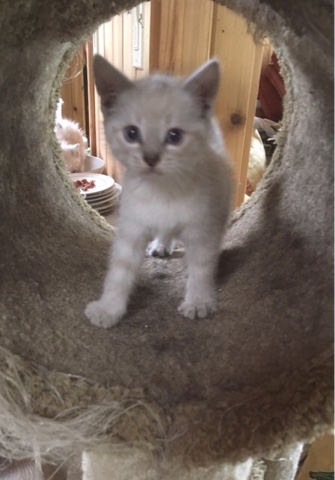
7- Bosco : dark Siamese marked male, 6 weeks old.
8- Pepper : light Siamese marked (mackerel tabby) male, brother to Bosco.
9- Nami : light Siamese marked (marble tabby) male, brother to Bosco. (pronounced nah'-me)
Nami
The Siamese marked kittens are part of a litter born on my farm, from a feral mother cat. (Mother is now spayed and released back to her territory.) I found a home for one of the litter before hubby announced that he wanted to keep the kittens together....that translates into keeping them here. They spend their days playing with Marco and Benji.
9 kittens!!!!! You talk about a population explosion! But they will all be neutered, thus be the end of their lineage. I'm hoping that some of them will become topnotch ratters. Right now the feral ones are living outdoors right by the house. The tame ones are living inside for now until they get a bit older. Yes, I'm going through a lot of kitty litter, not to mention cat food.
Are we crazy to take in 9 kittens? Most likely. But with a farm that has a constant rodent problem due to living next to an old macnut farm, these kittens will become valuable assets. I don't use rodent poison on the farm (dead rodents around could poison the endangered Hawaiian hawk plus other innocent creatures), nor snap traps which could injure the dogs, cats, and chickens. The old trashcan full of water trick doesn't seem to fool these rats. So cats are the best option.
Wednesday, December 19, 2018
First Lamb
The first lamb of this lambing season was born 2 days ago. Mom just brought him forward this morning to join the flock.
A boy, you heard right. Sigh. I wasn't looking forward to another ram. This guy is strong, active, and huge. And really pretty, so I might keep him as a back up ram just in case something happens to one of the other two. So I guess I'll need to think up a "ram name", rather than "Freezer Lamb #1".
Tuesday, December 18, 2018
My First Taro Giveaway
Something I enjoy doing is encouraging other folks to try growing food. So with the local Volcanoes Park unit having a holiday event, I saw it as an opportunity for a taro huli giveaway. Perhaps some gardener out there would be successful and develop an interest in growing taro too.
I figured on taking a dozen different colorful types, ones that might catch someone's eye. Plus I chose the easiest ones to grow.
Each huli needed to be gathered then trimmed up. And since these were heading to the National Park, they needed special preparation. Each had to be hosed and washed, removing all the soil. Then they were soaked in a bleach solution for 10 minutes. Once dried, they were then dipped in a sevin solution. All this was necessary to make sure that diseases and pests wouldn't be taken into the park. Without these procedures, the taro would not have been allowed onto the park grounds.
The white and orange survey tape serves as labels. Each huli was labeled with its Hawaiian name.
I brought 100 taro starts. Being that it was my first giveaway, plus the fact that I couldn't stay to attend the event to answer questions and offer help (I had an obligation elsewhere), I thought I'd start small. It would be a nice test. And if there were any left over, I wouldn't be swamped with trying to get them replanted into my gardens.
ps- Update : all the taro starts were taken. Whoopie!
Monday, December 17, 2018
Naalehu Holiday Parade
Night time holiday parade in town. Wow, how crazy, no? But boy, it was fun!
Lots of families came out and lined the street. And to my surprise and delight, there were plenty of parade participants.
And while the parade route was short, it was just long enough for everybody to get a front row seat. Ending up in our community park, everybody headed over there for free chili & rice while plenty of children hit the playground. It was a special time for the children. I'm sure that playing in the playground at night plus seeing Santa Claus will be a fond memory for a long time.
Plus the lite up trucks, tractors, fire engines, and ATVs were enough to excite even the child living inside the adults' hearts.
Ya know, things like this make my small town something special.
Subscribe to:
Posts (Atom)