Wednesday, November 13, 2019

Feeding the Farm Dogs

"T" asked me about feeding my dogs. Since we provide the bulk of our own food, what do we do about our dogs? Good question! 

Knowing what goes into making commercial pet food, I've been rather cautious what I feed my own dogs. Over the years I've used a variety of commercial dog foods and have had the opportunity to see firsthand how they effect my dogs. And because I used to show dogs, I eventually became a real dog food snob. Then once I learned what was in the meat by-product meal that many dog foods are based on, I became even more particular about which kibble I bought, eventually weaning way back on the use of commercial feed. 

Don't get me wrong. I'm not against anyone feeding their dog commercial dogfood of any sort. Most dogs will do fine enough on just about anything and everything. But working dogs and show dogs have higher requirements, thus doing better with some foods rather than others. And nowadays that I've moved to being more self sufficient, I've moved toward home produced and local food items. 

These days I use a good quality kibble and cooked brown rice as the basis of the feed. To that I add a soup that is made from products this farm produces one way or another. I have the option to use chicken, eggs, lamb/mutton, goat, pork, fish, turkey, and milk. I have a wide range of vegetables to pick from, often adding to the cook pot-- potatoes, sweet potatoes, pumpkin, green beans, carrots, peas, pipinolas, and a wide range of greens. Plus I take the dogs' personal tastes into account. While most of the dogs like tomatoes, Crusty won't touch them, not even soups containing them. 

How much kibble/rice I use versus soup all depends upon availability. Usually it's one cup of kibble, 1 cup cooked rice, 2 cups mixed soup. Each dog gets a different amount, depending upon their need. The dogs actually seem to enjoy the crunchies, thus I still add dry kibble. Just like us, they are texture oriented, enjoying a good chew in their meal. 

Could I eliminate store bought kibble altogether? Sure. And use something other than store bought rice? Sure. And perhaps in the future I may need to do that. But for now, this is what my dogs eat. It's not 100% farm sourced, but it's enough to satisfy me. 

Tuesday, November 12, 2019

Hammerhead Worms

Although I don't see very many, I do have hammerhead worms on this farm. This is a flatworm, or also called a planaria. They are a predatory critter that feasts upon earthworms. Yikes!!! Ok, ok, ok. Settle myself down. That's just how Mother Nature works. I just need to keep their numbers down so that they don't wipe out my healthy worm population. 

There are lots of different kinds of hammerhead worms, but I've only seen one type on my farm. It's a long, striped, somewhat gooey looking slimy thing with a blunt-ish head, not the striking hammerhead of other varieties. It's not robust like an earthworm, but instead it's rather fragile, easily broken apart into pieces. But that's not good. No, not at all. Because it's a planaria. And planaria can reproduce from those broken pieces, creating lots of new individuals. So simply chopping them up is making things worse, not better. 

To get rid of these planaria, I need to kill them. So far I've used a bit of salt to do that. Just like with slugs, I can sprinkle them with salt to destroy them. 

I don't actively go hunting these planaria, but sometimes I come upon them. It's always in a moist, dark spot, such as between two wet boards laying on the ground. Or deep inside a pile of wood debris. Or in the case of the photo, between two sheets of old roofing laying in the shade and that had been rained on, so that it was wet. 


So far I'm only finding these worms a few times a year. Their population hasn't been increasing.....so far, so good. 

Sunday, November 10, 2019

Biomass Definition

From time to time I've been asked what biomass is. I've used the term here in my blog. I've heard it used in a variety of situations, and I find that the meaning has a bit of a spin to it, depending upon where it is being used. But basically, biomass is plant or animal material used as a base resource for some higher purpose. 

On my farm, biomass can include:
...any and all plant material (leaves, twigs, branches, roots, grass clippings, fruits, etc) 
...any and all animal material (manure, bones, feathers, fur, meat, entire carcasses, etc) 

I'm a big user of biomass. It helps create my soil, is the main component of my compost, and provides me with fertilizer to grow my food and pasture. I use vast amounts of biomass to create my hugelpits. I use it for mulch. 

The term biomass is often used when referring to energy production. It is the base component for burning to create energy (heat, steam, electricity), and for making various biofuels. While I do burn some some wood for creating biochar, heating the house, cooking livestock feed, and (soon to be) heating water, mostly the biomass I collect goes into building soil fertility, by one means or the other. 

Much of the biomass I use comes directly from this farm. I'm in a good growing location, thus the greenery is constantly growing, giving my lots of trimmings, weeds, garden waste, etc. Plus I keep livestock, giving me plenty of manure. But I also bring a lot in from off the farm. This is because I am busily creating soil so that I can farm. Therefore I have brought in truckloads of gathered biomass for making compost, plus grass clippings for using as mulch. And whenever I find myself with extra biomass that I can't immediately use in the compost bins, it goes to filling in my hugelpits where I grow bananas. 

Biomass is the "fuel" that runs this homestead farm. 

Thursday, November 7, 2019

Why Mulch a Temporarily Unused Garden?

"S" emailed me and asked about why I bothered to mulch the soil in the greenhouse that isn't being used at the moment. She didn't see the sense of wasting the mulch or wasting my time. 

Actually "S", that's a great question. And by the way, you'll soon see that it isn't waste at all, at least not from the point of view that I'm coming from. 

Ok. First question to consider......why do I use mulch? 
1- to control weed regrowth
2- to retain soil moisture
3- to protect the soil microbes
4- to provide nutrients to the plants
5- to retain soil so that it doesn't erode or blow away
6- to feed the worms 

If you noticed, I applied water to the greenhouse soil prior to applying mulch. That's should give you a big hint. 

The soil in the greenhouse is fairly young. I'm in the process of building it up. In order to get a good soil ecology going, I've been using generous amounts of fresh compost, supplementing that with livestock manures and urine. To create a preferred environment for soil life, I've been keeping the soil moist and shaded. This has meant watering once or twice a week plus keeping the soil surface covered with mulch. If soil drys out or bakes, I'd be losing much of the soil microbes and other soil life (worms, springtails, etc). The soil life is what decomposes the compost and manure teas, thus eventually providing plant nutrients. It's actually a complex cycle, but basically that's what's going on. 

By covering the soil with mulch, even though I'm not presently growing a crop in the greenhouse, the soil life is preserved and is busily doing its thing. It's in somewhat of a holding pattern since there are no actively growing plant roots. But by being evenly moist and protected from sun, the soil life will do fine until I plant the next crop in the next week or so. The soil life will be able to re-establish their colonies and network, thus recovering from the light tilling by the time the seedlings start to grow. 

So "S", even though I'm not growing an edible crop, I am growing a vast colony of soil life. I utilize this soil life in place of commercial fertilizers. So having a thriving soil life community is extremely important to me. Even with an edible crop, I will tend the greenhouse soil, keeping it moist, shaded, and full of food for the soil life. 

Wednesday, November 6, 2019

Getting the Greenhouse Ready

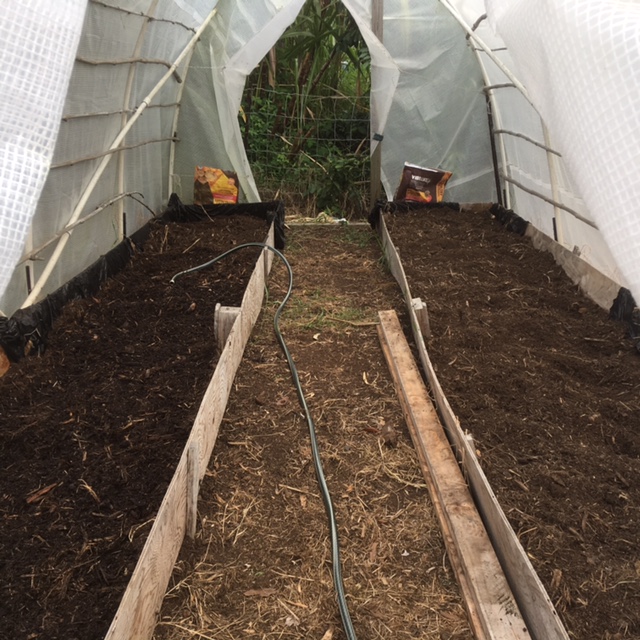
Greenhouse #1  ---  The crop has been harvested, the crop residue and weeds removed. These went into the compost piles. So the greenhouse was empty, the soil bare. As most of you know by now, I don't like to have bare soil. So until I had time to revitalize the greenhouse, I covered the soil with a light layer of county mulch, enough to keep the soil completely covered. 

Now I'm getting the greenhouse ready for replanting. The next step was to top the beds with a 3 inch thick layer of compost and till it in. But before I tilled I checked the soil pH, which was too low. Not surprising because I'm working with fairly new soil. A dusting of wood ash plus a sprinkling of dolomite lime will help this. Then I tilled this into the top 4"-6".

After tilling, the next step was to moisten the soil. In fact, I watered it well at a rate of one gallon per square foot. This got the entire tilled layer wet, plus some of the sub layer. 

I've watered the left side (the soil looks darker). Next I'll water the other side. 

I'm not done. Next step-- mulch. Whipping out the lawnmower, I harvested 6 trashcanfuls of clippings. I used them all, well mulching this greenhouse. 

One side is mulched. I did the other one right after taking this photo. 

 Now it waits in readiness.


Sunday, November 3, 2019

Bees And the Corn Dust

This morning I was using a bag of cracked corn to help catch some loose chickens, and during the process slung the partial bag atop the trap cage. A few hours later I came back to retrieve the bag, and to my surprise, there were honey bees in it. What the heck were they doing in there? I sat down to watch and observe.

Bees in the bag.

Watching bees work is fascinating. They're quite involved with whatever they're doing and appear to have no objections about being watched. In fact, I could gently brush them aside if I wanted a handful of cracked corn and they wouldn't object. I've learned from keeping bees that as long as I'm slow and deliberate, and gentle, the bees tolerate my presence quite well. 

This bee is diving head first, looking for more corn dust. 

Back to the bees..... So what was up? They were collecting corn dust. I bet there was corn pollen mixed in, which probably started this endeavor. Some scent caught their attention, and now a team was collecting the fine corn dust. I watched for over an hour, seeing one bee after another pack their legs before taking off, presumably returning to their hive with their protein prize. Each bee would initially clean the surface corn bits, then start delving deeper, churning over the bits looking to gather more dust deeper down in the pile of grain. With some individual bees, all that could be seen was their little pointed butts sticking straight up in the air. As I watched, loaded bees left, fresh bees arrived. It was constant activity.

The two whitish "pollen" sacks are quite visible on this bee's back legs. 

Friday, November 1, 2019

Harvest To Date

I'm just talking about the greenhouse experiment. Generally I don't keep harvest records. It's simple to figure out which varieties produce well and which don't, so I don't bother to count or weigh things. I know of plenty of gardeners and farmers who do, but I'm not one of them, at least not for now. I've got better things to do with my time. If something doesn't wow me with production, then I simply switch to a different variety. My motto -- produce or you're out. I just do what works for me. 

The greenhouses are an experiment. So I kept simple records. But I soon knew by watching the plants which ones I'll grow again and which ones I won't bother with. 

Results (to date)-----

Zucchini - 64
          While we don't eat lots of zucchini, we do use some. Plus it's a good trading item, so I will grow it again. The best performer was Desert. I'll stay with that one plus try one other parthenocarpic variety for comparison. But I will only grow a few plants at a time in the future. 6 would be plenty. If I start 6 new plants once a month, I should keep a steady supply of zucchini to meet our needs. 
          The plants last about two months before looking too mature. But then they are also suffering with fungal diseases. So by staggering the plantings, I hopefully will keep plants thriving well enough before I yank them at 2 to 2 1/2 months of age. 
          The greenhouse effectively conquered the pickle worm moth. In the field I was never able to get zucchini because of this pest, plus powdery mildew and stem borer. The greenhouse solved the pest issues. 

Cucumbers - 84
          We eat some though not as much as I grow, that's for sure. But like zucchini, it's a good trade item. Saber turned out to be the most productive variety. The growing conditions weren't ideal, so I'll try all the varieties again in order to compare. 
          The greenhouse effectively kept out the pickle worm moth. Powdery mildew is an issue, but the Saber variety did best when it came to fungal disease. 

Lima Beans - 18 cups shelled beans
          Both Dixie Speckled Butterpea and Jacksons Wonder proved to be good producers in the greenhouses. I also grew a lima called Succotash but it was a rather poor producer, so I won't grow it in the future. I never could get lima beans before when growing them in my open gardens, so the greenhouses brought success. I'll definitely keep growing lima beans in the greenhouse. We love these beans in soups. We managed to consume all those beans ourselves, using none to trade or sell. 

Sweet Peppers : 
Slim fryers - 82
Miniatures - 316 
Standard Bell - 17
           Pretty and Sweet was an outstanding producer of mini peppers, and unlike other minis I've tried which were rather bland, these had flavor. The Mini Bells were not worth the garden space. The skinny frying peppers were nice only in that they were very early and productive, but we weren't so apt to eat them. The standard bells all did fine. In the future I will grow the standard bells, possibly a plant or two of Petty and Sweets, and some frying types that I haven't tried yet. 
         The greenhouse situation made it possible to grow some decent sized, flavorful sweet peppers. When grown out in the gardens in the past, the peppers were small and tended to be affected by pests. So the greenhouse was a significant improvement. 
         Standard sized bells are the only variety people are interested in for trading or selling. Something to think about when growing peppers again. 

Tomatoes- 81 lbs
          Greenhouse success -- no fruit fly damage. No aphids (was this just luck?) No stink bugs.  
          Greenhouse problem -- powdery mildew and leaf spot. 
          So although I won against the pests, diseases were a problem that I don't usually get in field grown plants. Ah, a game of give & take. 
          All in all, I'd call the greenhouse tomatoes a major success. I've been getting plenty of gorgeous tomatoes. And I've been able to grow some of the tasty ones, which normally succumbed to fruit flies. 
          I grew 3 types of plum tomatoes, all of which I like (Orange Icicle, Black Icicle, Amish Paste). I plan to try growing these out in the field gardens to see if they are resistant to the fruit fly. Some plums are fairly resistant while others aren't. I grew 2 slicer types. One I liked well enough to grow again (Black Beauty) in the greenhouse. I plan to try other slicer varieties in the future.