Showing posts with label General Homesteading. Show all posts

Sunday, January 5, 2020

Once a Month Job List

I don't recall if I mentioned this before, but In order to make sure that certain things get done, we have a "first of the month" job list. 

... Check solar batteries and service as needed. 
... Clean the solar panels. 
... Apply once a month flea control on the cats & dogs. 
... Administer heartworm preventative to the dogs. 
... Deworm the sheep and donkey. 
... Give all the animals a quick exam, looking for early signs of problems. 
... Check condition of catchment water and add amendments as needed. 
... Check the inventory of emergency supplies and replenish as needed.  This includes propane and gasoline. 
... Check the condition of the field fencing. 
... Flush out the raingutter system. 
... Check farm equipment and service as needed. 

And finally......gather up all my work shoes and clean them. 

Lined up drying in the sun. 

There's lots and lots of other tasks that always seem to need doing, but these core jobs are always repeated month after month. Without having a monthly to-do list, I fear we'd never get these done in a timely fashion. I'm way too good at putting things off until tomorrow. 

Thursday, December 26, 2019

Tree Removal

A project I've been waiting to have done is taking down the dangerous eucalyptus trees near the house. When these trees get big, they often drop huge limbs. In really heavy wind, we've had the tops snap off or the whole tree come down. Since we plan to build some animal enclosures in the target area. I needed to have the dangerous trees removed so that they didn't crush any animals. These particular trees have been dropping limbs from time to time ever since we moved here.

Animal enclosures? Yes. When hubby retires he plans to have a small private cat sanctuary. So he is planning on building four "mini-houses" initially, then go on from there. 

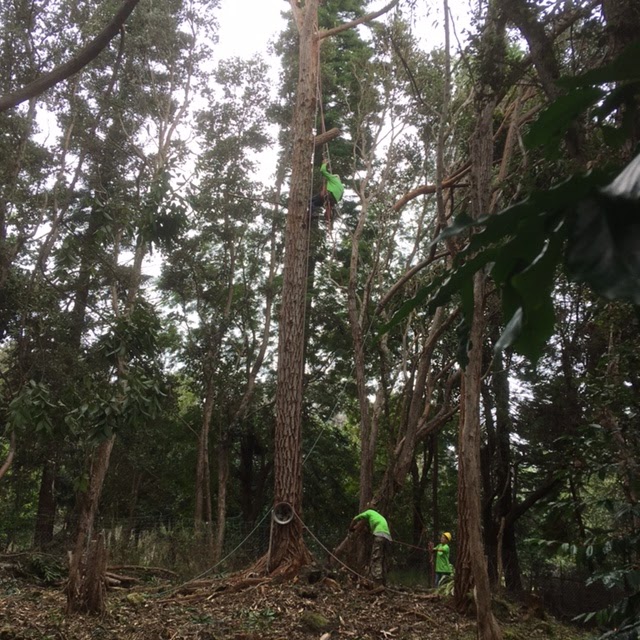
Climbing a tree. 

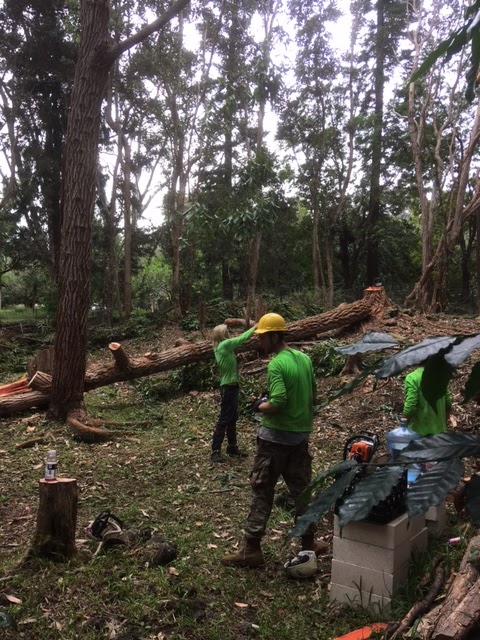
The tree guy we hired had to find a day when it wasn't real windy nor raining. That wasn't easy, but finally one came along that wasn't too threatening. So four people showed up early, armed with numerous chainsaws, climbing gear, ropes, and safety equipment. By 4 pm seven large trees were down and cut up in pieces. 

He's way high up there! 

The trunks were left in long sections, with hopes of cutting them up into slabs of some kind. David plans to buy an Alaskan sawmill. He needs to learn how to use it without ruining some nice wood, so I offered these eucalyptus trunks. He can practice and learn on them. And who knows, perhaps some will become noce tables and shelves. 

One of the 5 really big trees is down. 

Regretfully this location makes it impossible to bring in heavy equipment. I'd have to bring in a couple dump truck loads of fill in order to make it accessible to a chipper, sawmill, or even a backhoe. But since we're not in a hurry and David doesn't mind, we plan to try working with the tree trunks where they are. 

Tuesday, August 27, 2019

Farm Update

I've been kind of bummed out working on the farm these past two weeks. It's been far too wet for my liking. Lots of rainy nights and even a few day long rains. It's resulted in water laying here and there in the gardens due to the sub-rock being pahoehoe lava. I've been working in the rain, which surprisingly I don't really mind all that much. The rain hasn't been cold. But my feet complain about being too wet for too long. And then, there are plenty of things that I want to do that just won't work in the rain, such as till the gardens and mow the grass. 

Some of the plants aren't happy with all the rain either. Several of gardens of green onions came down with rot and died. The potato boxes have stopped giving me big tubers, so I'm ending up with far less than half the anticipated harvest. 

On the plus side, all the rain has meant that most of my cuttings are taking. I planted plenty of chaya, cholesterol spinach, pineapple suckers, and sweet potato cuttings....they all rooted. That was amazing. Normally there will be a percentage that fail. 

Since it appears that the climate change means that the farm gets more consistent rain, I need to think about protecting crops from excess moisture. Surely I could grow most things in greenhouses or high tunnels, but that means a major expense. I'm not ready to do that. In fact, I'm at the point where I want this farm to support itself. So the farm needs to earn money in order to build greenhouses or tunnels, or roofs of some sort over certain gardens. I'm going to have to mull this over. 

On another note, I've captured and sold the pigs. I broke down and purchased a professionally made pig trap. It wasn't cheap, but the sale of all the pigs actually paid for it. On my next post I'll show you this new fancy trap. 

Sunday, July 21, 2019

What's Up Lately

I know the blog has been rather quiet and non-informative, but our life on this homestead farm is seldom idle. What has been keeping me busy? 

... Filling up compost boxes. Compost is my number one fertilizer, so I'm always making more. It's not uncommon to spend an hour every day accumulating organic debris (from mowing, pruning, hacking down overgrowth, removing weeds) and transferring it to the bins. Then going out to the pastures and spending time collecting manure, which I layer in the compost bins. Yes, it would be far easier to buy sacks of fertilizer at Home Depot, but that's not the method I choose to use. 

... Repairing and maintenance. This seems to be never ending. Patching and replacing fencing. Installing new tarps. Replacing rotted out pallets and trellises. Repairing window and door screens. Doing maintenance of the tillers, mowers, chainsaws, weedwacker, etc.  Repairing damaged mini greenhouses. I do this work myself. It's part of being a self reliant homestead. 

... Planning the next big projects. Two biggies are pending -- replacing the house roof, and building a new chicken pen. Hopefully this will be the last time we will need to do either of these. Yesterday hubby measured the roof and printed out diagrams from our architectural house plans. So I'll be off to Hilo to order the needed roofing materials. While there I'll pick up supplies for the chicken pen. Trucking off to town like that uses up a full day of time. 

... Cashing in on some of our efforts. It's time to sell some livestock. I've put out the word and already have interest in two of the goats, a few sheep, and two piglets. 

... Replanting the food gardens. It's been raining a little bit almost every day now for weeks. So working the soil is difficult without damaging it. But I've managed to plant beans, taro, beets, herbs, and potatoes. I still have a lot I want to sow. We're eating a lot of meals out of the freezer right now, so I'll need to grow more veggies if I wish to keep eating our own homegrown foods.

... Hunting frogs. Yup. We had a bunch of cane toads move into the area. Most ended taking up residence in Matt's derelict pond. Two nights of wading through the pond in the rain, we managed to capture 5 toads. We also have coqui frogs in the area and we work to keep them away from the house (they can make sleeping difficult). We found and sprayed the one down by the gate that was torturing my neighbor, but we haven't yet got the one in the banana trees closer to our house. Tracking them down can take minutes, hours, days, even weeks of effort. They're not easy to find. 

... Building the rock wall along the driveway. It's inching along, but it will be months before it's finished. One of these days I'll have to measure how many feet of rock wall has been built so far.

... Cleaning and refurbishing the wwoofer cabin area. Yes, Adam has moved. It was time for him to take his next steps to becoming an independent adult. I'll still be seeing him once a week since we agreed that he would work on the farm on Thursdays. 

Living a homestead style farm life is what I like to do. But it surely isn't the life of ease. I really have to laugh when I hear social media types claiming that they are living the "back to earth" life on only 2 hours labor a day. Ha......sure......tell me another one. Maybe they really mean that they spend two hours a day playing in their garden and watching their chickens. But how about set up, maintenance, repairs? How about harvesting and preserving their garden bounty? Or cleaning up after their chickens? And exactly how much do they really grow versus buy from a store? Oh yeah, they claim they are totally living out of their garden, plus their chicken eggs, but I somehow doubt that considering they are putting so little time into it. And by the way, what do they do about the winter months where the garden doesn't grow and the hens don't lay? Breatharianism? Oops, none of my business! 

I'm still enjoying this lifestyle. My body is starting to wear out, but I figure I'll be doing this for a while still......and loving it. 

Thursday, May 16, 2019

Stacking Functions

Chatting the other day with "W" over a cup of coffee, "W", being still young and impressionable, was all enthused about permaculture. He wanted to share his new found knowledge, and he didn't know anyone other than me that would know what he was talking about. So there we sat, talking farming, environment, and ecology instead of the usual political moaning, government bashing, and local gossip. 

The one epiphany that awed him was the concept of stacking functions. This is a basic concept in permaculture design where elements serve more than one function. Being a young person, this seemed like something really new to him. With me, being old, it wasn't all that astounding. It's like killing two birds with one stone, a saying that has existed long before I was born.

Examples of stacking functions on my own homestead (although I'm not a permaculture farm, though I use ideas from all sorts of farming methods.....
... Cholesterol spinach grows in my Secret Garden. From time to time it gets straggly, so I prune it, giving it a new lease on life. The young leaves and tips I save and set aside for eating. The slightly older leaves and stems go into the livestock cook pot. The woodier stems go to the nursery for potting, thus creating new plants to expand the gardens. So my labor has stacking functions -- I am cleaning up the garden, improving the vitality of a crop, harvesting food for us, harvesting feed for the animals, and propagating a crop. 
... Plants can have multiple functions, such as my food forest trees. Some of my vining crops have homemade trellises, but others climb trees. Those trees are food bearing themselves, plus they serve as trellises for the vine crop. So the trees provide food, shade for a second crop to grow, and support for the vines. Of course trees also increase humidity, capture CO2, improve soil, provide mulch or compost material (fallen leaves), and eventually wood for firewood, wood crafts, and hugelkultur pits. 
... My chicken operation is set up as stacking functions -- the provide meat, eggs, and manure. They churn up compost (which I add to their pen), enriching it in the process, and removing any insects/slugs/mice. They process grass clippings that I give them into a nutrient garden resource. Their food is primarily garden waste recycled through them to become manure, and ultimately garden fertilizer. So they help rid the farm of excess waste and convert it to a valuable product. Plus their pen has a tarp roof from which I can collect rainwater. On top of that serious stuff, I find them to be a source of amusement....cheap entertainment. 

Most things on a homestead style farm have multiple functions. 
... A perimeter fence keeps livestock and pets in, but just as importantly keeps other animals and people out. The fence may also provide trellis support for crops such as peas or beans. Some fences can function as windbreaks or visual screens blocking out unwanted views. 
... A pond provides a pleasing venue for picnics in addition to  mosquito control, a place to raise fish or grow aquaponic lettuce, a source of compost or livestock feed materials (via pond plants), a source of water for irrigation or fire fighting, a beneficial wildlife setting. 

Stacking functions Is so normal for me that I don't even give it much thought. Everything on this farm seems to have more than one purpose. But to be truly stacking functions in the permaculture sense, it has to be in the design. Stacking functions afterall is a design principle. 

Some stacking functions I knowingly incorporated.....
...sheep. They mow the grasses and weeds, provide manure, provide lambs for sale, give us meat and milk. 
...our  little barn. It was built with the ideas in mind to be a secure storage building for equipment, house a workshop, give me a place to work on rainy days, an emergency shelter for bummer lambs, collect rainwater for the ag catchment tank, and serve as a sleeping spot for unexpected overnight guests. 

The thing I see about the permaculture principle of stacking functions is that it increases efficiency. One gets more done during a time period. Or gets more return out of a space or project. Or in the example of the sheep, eliminates the need for added elements, such as a lawnmower or the time needed for mowing or weedwacking. In permaculture, stacking functions is part of the design that goes into creating the system. It's not an after thought or a lucky bonus. As I was learning while creating my homestead, I naturally started incorporating multiple purposes. Without being aware of it, I was creating my own idea of stacking functions. I've gotten so bad that I can't bring myself to take a trip to town without stopping at the dump, checking out the dump thrift store for new goodies, picking up a gallon or two of fresh drinking water, doing my in-town errand, swinging by the post office to check for mail, perhaps stopping for a cup of coffee and a bit of conversation. doing a tad of foraging in the right season, and stopping someplace to enjoy the view before heading home. 

Tuesday, March 19, 2019

Getting Caught Up

Getting caught up seldom happens on this farm. I always have projects in progress. But these past few days I've been getting quite a bit done on some of those projects. 

Driveway rock wall --- I've been hauling rocks for days, a few at a time, multiple times a day. I've finally brought enough to build another 80 feet of rock wall. Believe me, that's a heck of a lot of rocks. But it feels really great to see that long section get completed! 

Hugelpits --- with it being a winter lull right now, I'm getting the opportunity to clean out the gardens around the house before things start growing like crazy again. All the weeds and trimmings are being layered into the hugelpit beside the driveway. You'd think the dang thing would be full by now, but the material has been decomposing over the years, thus settling down. This past year the level dropped 2 feet, giving me plenty of room to add more layers. I'm already growing a few banana trees around this pit and they are surely appreciating the constant compost. 

Pasture improvements --- the grass seed and oats I sowed the past 2 weeks is sprouting. Although it's just baby grass, it's giving a nice greeness to the pastures. I've also been seeding some various forbs that I know the sheep will eat, plus transplanting cuttings of kukui grass and guinea grass.  It will be many weeks before the sheep will be allowed to graze for a couple hours here and there, but after a few months they will be able to enjoy these pastures as part of their pasture rotation. This has been a big, big project and I'm glad to see some visual reward. 

Food gardens --- my neighbor, Matt, has been champing at the bit to get the gardens going again. I finally gave him the go ahead to start seeds. He turned all his garden areas by his house and I followed up by tilling the clods apart and removing any newly dug up rocks. He promptly got beans planted. Way to go, Matt! 

Main food garden --- this is the main project for this week. I've just started. The sheep have already eaten the grass down. And I followed them by using he lawnmower to scalp it closer. Now I'm tilling to bust up the grasses, turn in a layer of compost and manure. I'll do one 3'x20' area at a time and let Matt plant his seedlings and seeds into it. I'll post some photos at the end of the week. 

Manure clean up --- here's one job that most people don't do. But the manure is a major fertilizer source in this farm, so I collect it. I spent a few hours each day picking up donkey and sheep manure, putting it into a compost bin. I'll let it sit there for a couple weeks, heating up and decomposing a bit. It will be growing billions and billions of soil microbes, critters that really improve my soil. 

With these projects getting caught up on, I'll need to add a few more to the task list........
...plant turmeric starts
...collect banana keiki and plant them into new beds
...start sugar cane starts
...start sweet potato cuttings 

Yup, work is never done on this farm. There's always something waiting around the corner that needs to be worked on. That's ok with me. I'm still enjoying learning to farm this place. 

Thursday, February 14, 2019

Gasoline Storage

"B" noted that I use a number of gasoline powered tools. He wondered how I handled acquiring and storing gas.

Yes, I use gasoline. It's an expense and not sustainable, but regardless, I use it....and hope to be able to continue to use it for the time that I'm working this farm. Gasoline powers my generators, the one that boosts the solar batteries as needed, and the portable one that I use for power tools about the farm. I also have atv's that are gas powered. And I still use the gas chainsaw and weedwacker, although I tend to prefer the battery ones. It all depends upon the job at hand. The gasoline ones have a lot more power. 

Buying gas isn't a problem. 8 to 10 miles either direction along the highway are gas stations. I normally go by a gas station 6 days a week during my routine travels. Thus acquiring gasoline isn't a hassle. 

Storing : I don't store large amounts of gas. I normally try to keep about 10 gallons of regular on hand and 6 gallons of e-free. That way the gas doesn't get stale. 

I have a dedicated gasoline storage box. 


This was a box we had made for another project and no longer needed it. So we added air vents in the back for ventilation and use it for gas storage.


I normally leave the top propped open a tad for ventilation, plus to let rain run off. Oh, I could make some fancy do-dad to keep it propped at the desired angle, but the piece of 2x2 does the job just fine. 

Tuesday, January 15, 2019

The Dark Side of Homesteading

"T" liked my homesteading mistakes post, then he asked me if there was a unseen side to homesteading. "What? Do you mean a dark side? Those dirty little secrets no one tells you about?" Yes, there is. Going back to the earth is trendy now. Success stories sell magazines, for-profit blogs, money making YouTube channels. If they talked about the horrible things that happen, then they wouldn't have an audience for long nor make money. 

So what are some of the dirty little secrets? It may be good to be aware before plunging into any level of homesteading. You aught to go in with open eyes. Be aware that everything isn't roses and lollipops.  

... If you have livestock, they will eventually die. Sometimes it's ugly, sometimes expensive, sometimes a surprise, sometimes drawn out agony. Sometimes you find them peacefully looking like they're asleep. Other times there is blood everywhere. 

...Crop failures. There goes your food supply. Oops. It seems that everything out there is trying to kill your crop: bugs, diseases, the weather, the neighbor's cows. I once had Bucky, my wether, and his friend, E-Ram the sheep, eat my entire main garden. All-l-l-l gone! 

....Nobody wants your products. Making crafts is one of the first go-to ideas people have for making income. But there's a narrow market for such items and the competition can be huge. Selling your extra veggies is another grand idea. But there's not a guaranteed market, especially if you have a farmers market in the area. Or if they aren't pretty and priced right, you'll be taking them all back home with you. 

...Things go wrong.  The generator you depend upon stops running. You run out of firewood. Frost hits the very morning your seedlings germinate. You check your pond and find all the fish floating belly up. The milk cow gets mastitis. 

...Bad weather. The land floods. Or, there's no rain. Early frost. Cold spring. 30 cloudy days in arow. Strong winds blow everything down. 

...Doing things by hand takes a lot more time. Hand digging a drainage trench can take days, while using a backhoe can take an hour or two. Everything done by hand takes a lot longer to get finished. But sometimes by hand is the only way you can afford getting the job done. 

...Every homestead different, but each has something that eventually becomes an issue. Hauling water? (That can lose its appeal.) Long driveway to maintain? (Wait until the first real snowstorm.) Living off grid? (It takes discipline to live within energy boundaries. And you'll kill your first battery bank while learning.) 

...It's hard work. There's lots of physical work. It's not a part time job. Once the entire infrastructure is in place, then the work eases up, until you get bored and start taking on new projects. Yup, the work never ends. 

...Not glamorous as depicted in the glossy magazines, glitzy blogs, polished videos. That beautiful photo of the well groomed family of dad, mom, and two young kids holding bags of fresh picked ears of sweet corn is staged. Hate to break that to you. But if they had REALLY just been out picking that corn, their hair would be torn askew by wrestling 6' high corn stalks, their hands would be red from twisting and yanking all those ears off, their clothiers would be a mess with spider webs and dirt, and they wouldn't be lined up smiling like a line of Hollywood actors.

Homesteading has its rewards. Of course. Otherwise real people wouldn't be doing it. 

Monday, January 14, 2019

Homesteading Mistakes

A few readers have remarked that I make homesteading sound easy, and that I don't make mistakes. Oh brother, that's far from the truth. I've always said that farming isn't easy. It's work. And I make lots of mistakes, but maybe not the most common ones. 

Over the years I've talked with many a wannabe small farmer or homesteader. I'm often asked for advice. So here's a list of some of the things I mention in order to avoid having to deal with common mistakes people make.....

... Wrong location. Choose your location wisely. Consider the weather, climate, government restrictions and taxes, the area's future planning, your neighbors and neighborhood, availability of shopping and health care. There are a lot of things to consider, and each person has there own priorities. But I've heard of people buying without regard to land restrictions and are frustrated that they can't have a flock of chickens, or don't they have water rights, or they find out an interstate highway is planned to run adjacent to their land, or oil wells are planned the the land across the street, or their land isn't accessible by vehicle during the rainy season. 
... No cash or a job to bankroll your start. Too many newbies can't survive the first year because of lack on funds. It takes a while to learn how to produce your own food, and survive using less resources. If starting ftom scratch, it takes a while to build something to live in. It takes money to buy the tools and supplies you need. 
... Not everyone in the family be on board with the idea. Not everybody needs to be an active participant, but they can't be against it. 
... The First Year Syndrome : trying too many things at once. Most people fall victim to this. They try to get everything done at once. 
... Constantly looking for the perfect or best way to do things before acting. Some people get paralyzed trying to decide what is the best way. They want to do it right the first time. As a result, they never get started. It's called analysis paralysis. Other people go ahead a do something, but then re-do it over and over again, looking for the ideal ultimate way. Every year they tear down what they did the year before and rebuild it, or sell last year's "the ultimate goat breed" and buy a different one. 
... Over estimating your ability. With the advent of easy access to information via the Internet, newbees tend to over estimate their knowledge and skill to farm, have livestock, build a house, maintain farm equipment, grow a garden, etc. They figure that they saw it on YouTube or read someone's blog and that they can do the same thing successfully right away. They don't realize that experience has a lot to do with success. It takes hands on work and time to be successful at just about any and all aspects of homesteading and farming. Believe me, if you've never gardened before, plowing up two acres and buying a couple hundred dollars of seeds is a big mistake. 
...Growing too big too fast. Expanding sounds like a good idea. But if the foundation isn't there to support the growth, you get over extended in a hurry. What too often follows? A big crash. 
... Not knowing about the livestock before you buy. I've seen people buy a type of livestock that appealed to them without learning anything about them first. Emus. Alpacas. Potbellied pigs. Scottish Highland Cattle. Buffalo. This even includes the more common goats, sheep, rabbits, etc. And I've watched too many of those animals die, or worse yet, the new owners getting badly hurt by them. 
... Not having infrastructure in place before buying livestock. This is far too common a mistake. A person visits a livestock auction (by the way, that's a terrible place for a newbee to buy an animal). They come home with 6 diary goats and tie them out on ropes because they don't have any fencing in place yet. Nor do they have the equipment or skill to milk them. Nor the feed on hand to go feed them correctly. Nor a water trough. Nor a shelter. Believe me, I've seen this happen! For real! My advice is to have everything in place before the first animal arrives. 
...Not having livestock evaluated before purchasing. When buying animals, one needs to be able to evaluate their health, temperament, confirmation, and suitability for the reason they are being acquired. If you can't do it yourself, then get help from someone that can. I've seen people buy scouring calves, not knowing what was going on. Other times it's been piglets loaded with lice, sheep too aged to be of much use, goats too anemic to survive, hens past egg laying age. As a teenager I got stung buying what I thought was a gelded pony, only to find out later that it was a cryptorchid stallion. Yikes! 
...Trying to home slaughter and not knowing how to do it. Gee, I've gotten nightmares over this common mistake. I've heard grewsome tales. 
...Raising animals for food only to find out that you can't bring yourself to kill them, or eat them. Wow is this common! Once you've looked into an animal's eyes, given it a name, tenderly cared for it, it gets difficult or impossible for some people to keep in mind that this is food. It gets killed, cut up into pieces, and served for dinner. And it gets worse when the kids can't bring themselves to eat Bossy, Elsie, Little Red, Thumper, etc. I've seen these type homesteaders drowning in livestock that they can't bring themselves to eat, kill, sell, or give away. 
...The family is glued to supermarket food. I've seen families where they don't eat what the grow, and I'm not referring to animals. To them, real food comes from a store, and most is prepackaged commercially prepared meals. 
...Not understanding that farming goes on regardless of the weather. Rain. Freezing cold. Broiling summer days. Storms. Mud season. Snow. There are jobs that need taking care of regardless of the weather, especially when there's livestock. No livestock? You're not off the hook. Got tomato seedlings out in the coldframe and there's a snowstorm scheduled for tonight? Well you gotta go out in the cold and dark to cover that coldframe with straw and tarps, or piles of wet blankets. 

I'm sure there's plenty more common mistakes that beginners make, but these are what came to mind ..........because either I made them myself or watched others who did. 

Sunday, January 6, 2019

Emergency Food

"T" asked me today via email about what sorts of foods I have stockpiled for winter use and emergencies. It seems that he lives where they just had a deep snowstorm and weren't prepared with back up foods in the house. So thoughts of a well stocked pantry are high on his list.

Winter use: In Hawaii, that's not a concern. I am able to garden year around. That's one of the reasons I opted to move to Hawaii. So rather than talk about storing find for winter, I mention storing excess seasonal foods. 

While I can grow many things year around, there are some crops that are strictly seasonal, while others tend to produce better some times of the year and poorly the rest of the time. Just like in most areas of the mainland, cool season crops do better during the winter months here, things like broccoli, cabbage, cauliflower. So yes, there are foods I tend to store, but not in excess. We are more apt to simply eat seasonally. 

Some crops are strictly seasonal. They're mostly fruits. Seasonal foods that I preserve: 
... Pineapples. I save this by either drying or freezing.
... Lilikoi. I juice them, then freeze the juice. 
... Avocado. I'll mash a few and mix the mash with lime juice, then store in the freezer. Once thawed, it's good for making guacamole, which hubby enjoys. I'll also use it as an addition to soups or as a "gravy" in stir fries. 
... Mango. I scoop the flesh into nuggets then freeze it. 
... Turmeric. Dehydrate then freeze for long term storage. I could just freeze it, but it works better for my uses to dehydrate it first. 
... Citrus except lime. I'll juice the fruits and save a few containers of each kind of juice. Limes produce year around, so no need to store extra. 
... Jaboticaba. I'll make this into a syrup and freeze it. 
... Coffee. I'll process the beans to the parchment stage then store them in my barn until roasting time. 

Excess also can be preserved but I don't fill my freezer with too much excess. 
... Bananas. I'll freeze a few dozen to carry me over until the next bunch is ready. Bananas seems to one of those crops where you either have none, or so many that you give them away. 
... Assorted veggies. I'll normally pop a few broccoli heads, cut up cauliflower, carrots, and peas into the freezer. Not much. Just enough to add easy variety to our meals. 
... Bulb onions. I have green onions year around, but I also grow plenty of bulb onions because we use a lot of them. Bulb onions all mature in the summer, so I end up with a seasonal excess. I usually just coarsely chop them up and pop them into the freezer for adding to soups later on. 

Of these excesses, I prefer to use most of them for trading or selling. 

Let's talk about emergency foods for a moment. I do keep a bit of food stored for an emergency. Emergencies I can think of would include a major hurricane, volcanic eruption, or a shipping disruption (strike, war, port damage, etc). Regardless of the emergency, we'd need food. We do have plenty of food growing about the farm, but it wouldn't take long to become insanely bored eating bananas, pipinolas, sweet potato greens, and eggs for every meal. So I keep an assortment of things growing around the farm, and I keep an assortment of veggies and fruits in the freezer. Not a freezer full, but enough for a couple weeks. I also have dry beans, lentils, rice, and peas stored in sealed mason jars for soup making. And a few pounds of spaghetti and jars of homemade spaghetti sauce stored as well, just for quick & easy meals.  We have livestock living right on the farm, so if push came to shove, they could be added to the dinner plate. Unlike people living in urban areas, we live amid a trove of food. It's one of the benefits of having one's own homestead farm. 

Thursday, November 22, 2018

Continuing With a Rock Walls

It seems the just about every project I get involved with ends up with a pile of rocks. No problem. There's always a rockwall that can be added. 

I've been working on making new garden beds along the driveway margins. Plus I've been removing surface rock from the pasture areas I'm improving. An almost constant source of rocks. 

Here's the new stretch of wall going up along the driveway. It's far from being done, but it's on the way. 


For years I've been adding walls to line the driveway, and I'm not even close yet to running out of driveway. Yes, I've got a really long driveway. But you know, it's starting to look really nice. I find that driving up toward the house, with rockwall and gardens lining each side, is really "rich" looking. 

Friday, November 2, 2018

Using The Garden's Tidbits

I wrote this little piece a couple of months ago as lecture notes for a gardening presentation. I thought it was good enough to include on my blog.......


Often times the garden doesn't produce in abundance. So sometimes there's just little tidbits of something, not enough to make a meal out of by itself. I see this happening to small gardeners around me, but it also happens frequently enough to me too. Even though I'm sure that I'm planting enough, the curse of  bad weather, disease, pests, the sheep getting out of ther pasture, a neighbor's cow wandering through, all take their toll. So sometimes I don't get much return on a particular planting. 

The learning process to grow a new crop also can lead to a sparse harvest. I can't count the number of times I was happy just to get a few carrots, or perhaps two sweet peppers, while trying to master a crop. I've seen other gardeners having the same challenge, so I'm not alone on this. 

One other reason I might bring only a small handful of something to the kitchen is that it's the beginning or end of a normal harvest. There's always some plant that produces a few days earlier than its bed mates. And of course, some plant straggle behind at the end. 

So, do I toss those 3 cherry tomatoes into the pig food bucket? Only one carrot ready....do I bother with it? Only one mini broccoli ready to pick a week ahead of the others.....feed it to the chickens? No, not usually. Having tidbits is common. The first....or last, sole cucumber, summer squash, cucumber. It happens all the time. Since I don't tend to preserve my excess (freeze, can, dehydrate, pickle, etc), I have to use those tidbits creatively. Here's some of the things I do......

... Have a meal of "finger foods". Each plate might end up with half a carrot cut into strips, a few slices of sweet pepper, a few slices of cold boiled sweet potato or Irish potato, all for dipping into a sauce. A hard boiled egg.  Half a cup of yogurt with a handful ground cherries (or that last piece of pineapple, cut up) mixed in. A few cherry tomatoes. We've come to like a finger food dinner. You never know what it will contain. 
... Stir fry. Just about anything can go into a stir fry or a sweet & sour dish. It's a great way to utilize tidbits. 
... Soup. Start out with a basic stock soup then add the tidbits. Top it off with some seasonings and you've got a meal that used all those stray veggies. I've added lettuce, radishes, even cucumbers to a mixed soup. 
... Mixed salad. This is another meal that we are very flexible about. Most veggies, fresh or steamed, go fine with a mixed up salad. I've been known to chop up that sole last banana into the salad, or slice up those two strawberries rather than toss them to the chickens. 
... Omelets, quiches, fritattas are great ways to use those solo veggies. Only harvest three spinach leaves? Into the omelet they go. 
... Sandwiches. Our sandwiches can sometimes look a bit weird to outsiders, but heck, I don't force people to eat them. If you look closely at the egg salad you will sometimes see shreds of carrot, green pepper, green onion, leftover cheese, minced tatsoi leaves, diced tomato. You never know what may be in there. 
... Spaghetti sauce. I believe that spaghetti sauce is a fair place to dump garden tidbits. Just about anything could end up in the pot, including chopped fruits and macnuts! 
.... Smoothies. Like spaghetti sauce, a smoothie is a dumping ground. Start out with yogurt and go from there. Anything goes! 
... Grilled kebabs. Marinate, skewer, throw it onto the grill. Yum! I can use even that one snow pea or cherry tomato, as long as hubby and I don't fight over it. 
... Glop for stuffing potato skins, peppers, scooped out pumpkin, etc. I'll usually mix the tidbits with rice or pasta to make the stuffing or topping. 

I've been known to blenderize leftover mixed veggies and stir then into gravy for topping baked potatoes, rice, and making hot hot gravy sandwiches. Mixing those chopped tidbits, along with herbs, with cream sauce makes for interesting toppings over pasta, rice, bread, etc. 

One of the many suggestions I make to new gardeners is to be flexible and creative with their harvest.......or keep a couple chickens. I feel it's a shame to waste all those tidbits by just turning them back into the garden. Worse yet would be to toss them into the trash can. Just about everything that's been cooked can be blenderized and stirred into the chickens' mash or pellets. The hens will clean it up and turn it into eggs, meat, fertilizer. (ps- chickens may not eat certain things raw, nor if presented whole, but cooked and blenderized my hens eat it all. I mix the garbage glop with chicken pellets to absorb the excess liquid.) 

Tuesday, October 23, 2018

How Gates Work

Here's something that new gate owners often get wrong........gates open downhill. I've seen lots of new people, hubby included, that tried to open a gate to the uphill side. That doesn't work. The gate gets stuck on the ground. The only way it can swing freely is to the downhill side. 

Here's a typical gate.......


This is the only way to get it open so that a car can pass through.....


Knowing this is important when you install a gate. You need to make sure there is enough room to fully swing it open on the downhill side. 

This particular gate is homemade. Bent tubular piping with 1/4" bars welded to it. All galvanized metal. Gate posts are reinforced cement pillars. Simple clamp style hinges. 


Simple chain & hook, and welded "latch". 


It works quite nicely and is close to 20 years old and still functioning just fine. Just don't forget to open it downhill. Otherwise you could damage the gate and its hinges. 

Saturday, October 20, 2018

Past Few Days on the Farm

Since the blog has been quiet for a couple of days, I'm now getting emails and text messages to check if I'm alive and well. Thanks you. The answer is, yes. 

Daily homesteading farm life isn't all exciting, nor interesting. The past few days have been typicall......

6 am, rise & shine, but (sigh) the mornings have been mostly dreary. No sun, everything drab looking. And everything soaking wet from the previous night's rain. Normally I'm awake before 6 am, but it has been just too blah to want to get up and going. 

First things first.....stagger out to turn in the generator. Once again, the day doesn't look promising for sun to charge the batteries. The solar battery bank is getting old and needs some help (sounds like me!), so on sunless days we tup them up in the morning and if needed, again in the evening. Next on the addenda, feed the critters. Cats. Dogs. Pigs. Chickens. Sheep & donkey. In that order. If I go out of order, there's a rebellion. I think I control these animals, but in reality they've made me their obedient slave. <<<<<<echoes of Feed Me Seymour wafts through the air>>>>>>

Before I can move on to making coffee and breakfast there's one more task. Take the rain gauge and temperature readings. I've kept a daily record since 2004 and its come in handy. The past couple years I've been posting it on a website called CoCoRaHS. If you're curious to search me out, I'm station hi-hi-12. 

Finally, it's people breakfast and time to check emails. I'll scan the news headlines but seldom ever read the articles first thing in the morning. It's too upsetting, so why ruin my day? The headlines alone piss me off enough, thank you. 

From now on each day varies, but the past few have been working in the rain or between showers. Rain makes things go slower and unpleasantly. I deal with walking the fenceline in the rain (if I use the atv, then I have to spend an hour hosing it down and drying it off afterwards). Gathering livestock food....in the rain. Happily the feed cooker is under a roof, rain protected. Next, checking the clean laundry which has been hanging in the rain for days. Today I moved each piece to a line I temporarily strung up inside the Costco shed that I normally use as a workshop. Looks like a giant spider web in there now. 

I've also been dealing with escaping pigs. Daily. The rain has softened the ground so much that the young pigs have been successfully rooting along the fence. Thus they've created holes where they can shimmy under. I made a quick bandaid fix by tying pallets along the outside of the fence.


 This has prevented them from lifting the bottom of the fence and crawling out. Just a bandaid repair until I can get in there to make a proper solution. Right now the pen perimeter is so muddy that I don't want to deal with it. Well, I did deal with it somewhat. The two worse offending pigs went into the freezer. Now I just have the two nicer pigs, the two who come when called and willingly re-enter their pen like polite little piggies. 

Another mundane task......replace a flat tire......to the sound of thunder. Great, what next? Don't know how it happened, but as I approached my driveway one of the tires on the truck went flat. Totally flat. Found out it had gotten a slice in the sidewall. Heaven knows what I drove over, because I never located the offending piece of metal. Whatever it was made a two inch slice. Totally ruined the tire. As dismayed as I was over the loss of the tire, I had a worse problem. I had a disabled vehicle blocking my driveway. So I had to do something about it. Of course, I was home alone. Sheesh. Yes, I know the mechanics of how to change a tire, but it wasn't something I wanted to do. But 1 1/2 hours later I had the spare properly mounted on the truck, truck parked back up by the house where it belonged, and the portable generator & tools all put away. When all was done, it was quite the rush to know that I had done it all by myself! Wahoo! 


By the way, those dang tires are heavy. And the stupid little jack takes forever to jack the truck up to the proper height. The jack was the most time consuming part of the whole job. And although I survived this task, I don't wish to do it again anytime soon. 

The only thing that felt like an accomplishment was that I spread 50 lbs of oat seed back in parts of the pastures. All this rain should get it to germinate with no problem. Plus I spread another 25 lbs of annual rye seed in bare patches around the farm. I'm not looking to harvest these crops for seed. The intent is to increase the grass for the livestock. My pastures still aren't great. Actually, they're barely passable. I've been gradually clearing out ferns and scrub, opening up more space for grazing. The oat and rye should help.  


Wednesday, September 5, 2018

Whistle

Boy, you guys are observant...... "E" just emailed me asking what was dangling from my wrist. 

Ok, working on the farm I don't wear jewelry, so you can rule that out. And I don't believe in talismans and lucky charms. It's not a mosquito repellent gadget. It's a whistle! 


When I first got Noodles, I would whistle to get his attention and train him to return to me. He responded really well. But as he grew bigger, he ranged further and further away. You see, he has a full 20 acres here to run around on. So sometimes he was out of range of my measly weak lip puckered whistle. Hubby suggested using a small but shrill whistle that is sold on Amazon. So we ordered a pack of four. I choose the black one to put on a ring and slip over my wristwatch band. 

Noodles is a big boy now, but I still use the whistle to call him. It's shrill, piercing, and carries a distance. 

Even if I didn't have Noodles, I like the idea of carrying a loud whistle on me at all times. I usually work alone, so if something were to happen where I couldn't walk back to get help, I could try to attract attention via the whistle. It has it's nice safety feature side to it. Yes, even if I don't have a farm dog, I'll keep wearing the whistle. It's small and I usually don't even notice that it's dangling from my wrist. 

I can hear it now.....why don't you just carry a cellphone? Yes, I already do that. The cellphone is almost glued to my hip. I carry it everywhere. But most of the farm isn't within cellphone range. Nada. Dead. Zip. So the whistle has its value. 

Thursday, June 14, 2018

Farm Update

This farm is gradually getting back to normal. The volcano eruption caused a bit of disruption due to the ash falls and increased vog, but I've learned to handle it. (I either needed to learn or give up in defeat. Learning was the option I choose.) The main .....and ongoing....... problem has been too much rain combined with too little sun. (As I'm writing this, of course it is raining and cloudy. Gee, what's new?!) This has led to excessive weed regrowth, grass that can't be mowed on schedule and thus overgrowing, garden soil that is often too wet to work, seedlings and crops that rot or mildew. It's been a piss poor year to date. But that's what farming can be like. It's not always a life of sun & roses. 

Although the rain guage is still registering almost daily moisture of some small amount, the ground is actually workable. How about that! No longer mud. We are seldom getting sunshine, but there's enough now to grow most crops, albeit slow growing. I've been sowing a few test plots to determine which crops will grow under the current conditions, and some are doing adequately. So it looks like I'm willing to risk planting again. I've noticed that other farmers in the area are coming to the same conclusion. I've seen them out in their fields, trying to get crops restarted. 

Although the farm has been basically on pause for several months, I'm still getting food for our own table. But I'm not getting enough excess for selling and trading. What's harvestable? 
...Assorted greens -- Okinawan soinach, cholesterol spinach, pipinola and sweet potato tips, chaya, assorted Chinese greens, radish greens, onion tops. 
...Assorted herbs are harvestable for home cooking. 
...Plenty of mamaki and lilikoi leaves for making tea. And plenty of coffee beans stored away. 
...There are still potatoes and sweet potatoes stored in the ground. Plenty. 
...The cherry tomatoes are producing enough for salads several times a week. 
...The onion crop is just coming in, and while there are plenty of onions, they are small. I'm used to hardball to softball sized onions, and these are hardball or smaller. So I'm getting a lot less onions this year. To compensate I will need to grow non-bulbing green onions for the rest of the year. 
...I'm getting a bumper crop of pineapple guavas, I guess due to all the rainfall. Normally I don't bother with them, but since there are insanely plentiful, I've been collecting them for making syrup and adding to my breakfast yogurt (I've been freezing them). We also like them fresh in a mixed salad. 
...The banana trees are producing the best I've ever seen them. Guess they like to extra rain. So we are getting enough bananas for both us and the livestock. 
...Pipinolas are doing really great right now. Plenty for both us and the animals. 
...While the pineapples aren't ready for harvesting, I can see that we should get a nice crop as long as diseases don't get them. Many of the plants are flowering. 
...Papayas are coming in steadily, though not overly abundantly. There's enough for our needs. 
...The taro looks good though I suspect the corms will not make good smooth pa'i'a because of the excess water in the soil. It might be lumpy. I've noticed in past years that my dry land taro does better with steady moisture but not the off and on again deluges. We are not poi eaters but I do eat pa'i'a (pounded taro corm without the water added like when making poi) pounded with herbs. And we also eat some of the leaves and stems occasionally in certain dishes. The rest that we don't eat goes into the chicken and pig food cook pot. 
...The lilikoi is just coming into bloom right now and the vines are loaded with buds. Looks like a good crop coming this year. 

Lots of things are missing. No broccoli, cabbage, cauliflower, beets, carrots, peas, beans. The chard, squash, and cucumbers all went moldy. The sweet peppers rotted, though the little hot ones that we don't eat actually are doing ok. The small amount of corn I tried molded in the ear. A total loss. 

In the livestock quarter, things are fine. We have enough eggs and meats. And we have been given assorted cheeses to be "paid" for with future veggies. Gee, I'm in debt. Swore I'd never go into debt again in my life, but here we are.... in cheese debt. 

We're doing fine. I'm cheating by buying a variety of veggies at the local farmers market. But if we had to survive on just what the farm produced or traded for, we could be doing fine. We'd just be seeing less variety on the dinner table. And since that last time I talked about being food independent, we've developed a cheating habit. We now eat Greek yogurt with our daily breakfast. We both feel physically better adding the yogurt to our diet, so I plan to keep it up. We will just plan to produce a bit more eggs or resale veggies to keep the financial balance. The farm is producing our food either by growing it, trading for it, foraging or hunting it, or selling excess and using that money to buy what we don't produce ourselves. 

All in all the farm is progressing. Most of the compost bins are cycling, producing plenty of fertilizer. The chicken flock is definitely producing fertilizer, believe me! Boy, can those birds process food! The young lambs are growing, and the ones I sold have already left the farm. The two piglets are getting bigger and friendlier. I've just spent two days mowing the weeds down in preparation of rototilling the garden beds. I also found and eliminated two yellowjacket nests......ouch! Yes, that's how I located them in the first place. I got a number of stings. 

Now that I'm getting back to farm production, I'll start posting about how I'm doing things here. 
 

Tuesday, June 5, 2018

Ash Cleanup

Now that Halema'uma'u is taking a rest from ash erupting, we put the effort into cleaning up ash. Since my last mention of ash clean up, lots of you have offered suggestions. Thanks! Your ideas were great!

Here's the ash that we're trying to clean up. Enough collected on our solar panels for me to collect some as a souvenir. A lite dusting looks whitish grey, but a pile of it shows its true color -- moderate ashy grey. 

 
First of all, "W" directed us to a pressure washer that he thought would work with our marine pump. 


By using a different hose than we normally use ........we hooked up the pressure washer using a 25' hose, 1" diameter hose.....the washer works just fine. A standard 100' 5/8" garden hose couldn't deliver enough water fast enough. This is a small pressure washer but it is doing a good job for our needs. We were able to clean the solar panels fairly well. 


It blasted the black ohia tree gunk off, and it appeared to take the ash off too. But when the panels dried, they still had a light covering of ash. That ash is really persistent. So we moved on to the next suggestions. Many people suggested hardwood floor mops. And one friend actually presented us with a gift of a mop this past weekend. It's a flip mop for hardwood floors. We gave it a try......


Worked super!!!!! Having blasted off 99% of the ash, the mop was able to clean the panels the rest of the way. 

Thanks everyone for your suggestions! 


Tuesday, May 29, 2018

Cleaning Ash From Our Solar Panels

Ash is accumulating on the solar panels. This ash from the volcano tends to be sticky once it is moistened. So removing it requires more than just a hose. Aside from the growing things on the farm (both plants and animals), the ash also is causing problems with our solar electric generation. Laying atop the panels, the fine layer of ash is interfering with generating electricity by blocking the sunlght and thus we're not getting our batteries properly charged. Being totally off grid and not wishing to run the generator all the time with the price of gasoline being $3.80 a gallon, getting those solar panels cleaned is a high priority.!!!


Initially we were hosing them off twice a day. This removed some of the ash, but we noticed it gradually building up. Soon it became obvious there was a problem. If I used a rag and I could reach a 3 foot wide area around the border of the solar panel set up, but couldn't reach further. A better solution was needed. Someone suggested a pressure washer. Good idea but we can't run one without buying a bigger water pump. Our water system uses a dc marine pump, too small to supply the necessary water volume for a pressure washer. So I was looking around for a different solution. I rag on a stick might not be a good idea, because if the stick poked through the rag it would damage the solar panels. 


I thought of a car washing brush, the kind that runs water through it. Might do the job nicely and quickly. A good friend of ours lent me theirs. So far, so good. If it works well, I plan to order one. I already tried our two local hardware stores and auto store, but no luck. So I'll need to look further afield.

Setting things up was easy. Attach hose, turn in water. Watering the panels down and rinsing off what ash I could, I then sloshed on a couple buckets of soapy water, just for good measure. Now it's time for the hose/brush. 


Quickly I learned that I needed a step stool. The brush with hose attached was heavy and awkward to use from the ground. I retrieved the stepstool from the kitchen. Too short. Replaced that with a step-ladder. Ok, I'm in business now I thought. 

Using the hose/brush, I quickly learned a few things....
...It's heavy. The brush and pole are light but add water and the weight piles on. 
...It's very awkward to use while balanced atop a ladder. It's a bear when reaching the center of the panel bank.....no leverage, really difficult to steer. 
...Once the panels are wet it's impossible to see where I've brushed them already. The brush seemed to work, but it was very difficult to make sure it's got the entire panel effectively. The brush needs to be at the right angle or it doesn't remove the ash. General swishing about doesn't do work. Once the panels dried, I saw that I missed about 50% of the surface. 50% removal of ash isn't good enough, especially since some parts were fairly clean and other areas still heavily coated. 
...The plastic pole isn't strong enough. This tool might be perfect for washing a car at ground level. But holding it higher above the ground appears to put more pressure on the plastic pole than it can deal with. The water on/off piece broke almost instantly, necessitating a trip to the hardware store to buy a replacement. The weight of the hose filled with water was too heavy. 

So I'm back to looking for an easy yet efficient way to clean the solar panels each day that we have ashfall. I might be looking closer to that rag-on-a-stick idea. Perhaps I just need to modify it a bit.