Wednesday, May 7, 2014

Drivel - Flume Hike Today

Yesterday was a day to explore Hawaii, specifically Ka'u, where I live. Our local Ka'u Coffee Mill is hosting a coffee festival and as part of the activities, a hike way up on the hills to the old water sources was offered. I immediately signed up. Getting access to those remote areas is almost impossible, unless one is willing to hike in, camp out for weeks in the wet, and work your butt off doing some preservation project for some conservation group. But today a bunch of mostly old foogies got four wheel drived to the end of the old access roads way up in the Ka'u Forest Preserve, then had the opportunity to try to kill themselves hiking a challenging trek over often muddy, slick trails. Right on! 
The hike was all about water. Not rain, but about the old sugar cane flume system. Back when sugar was king, water was gold. In Ka'u, water wasn't for irrigating the sugar cane. No. It was for operating the flume system that transported the cut canes down to the mill for processing. Flumes required a lot of flowing water, and Ka'u sugar company had a problem. There were no flowing streams. Water only ran in stream beds when it was raining. 
In the late 1800's, the need for large consistent volumes of water led to a water system high in the hills above the cane fields. Spots were identified were water was seeping out of the hillsides, especially along deep gullies. Tunnels were then hand dug into the mountain at a junction where overhead a-a lava met a lower ash layer. These tunnels collected water that filtered down through the overhead lava but couldn't drain through the ash, thus flowing out the tunnels into flumes to be carried down to the cane fields below. Dozens and dozens of tunnels were excavated, though most are blocked or caved in today. 
The original flumes were wooden and have long since have rotted away. Replaced with aluminum flumes after WWII, some are still in good enough shape to be restored and actively used today. In the above photo the flume on the left is an old restored flume currently carrying water down from a distant tunnel. The 12" PVC pipe on the right has replaced an old aluminum flume, and it now carries the bulk of the water being harvested today. 
The discarded old aluminum flume pieces have been put to good use. Some are being used to cradle the PVC pipe, some used for foot bridges. In this photo two were riveted together to make a ladder for scaling a rather steep section of trail. 
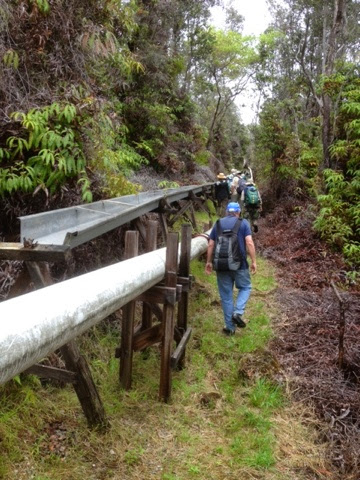
Sections of the disused aluminum flume still run side by side with the new PVC pipe. Surely some future extension of the water system will put these pieces to work once again. But today it's interesting to see the old open flume system as it was used in the sugar cane days. 
Looking right up the flume gives a good perspective. These old flumes went on for miles and carried quite a lot of water. Every one of these pieces had to be carried in piece by piece. No trucks could be used here. Along the way we saw the remnants of the old wooden flumes, long since rotted by the damp environment. It's amazing how much labor went into making this water system. 
In the above photo, the water pipe transverses a shallow gorge. The original trestle was wooden and looked like a pile of pick-up sticks from the decades of patches and repairs. So aluminum flume sections were used to rebuild the trestle. The sections also came in handy for making a foot bridge below. 
The footbridge is a bit narrow, but quite walkable. 
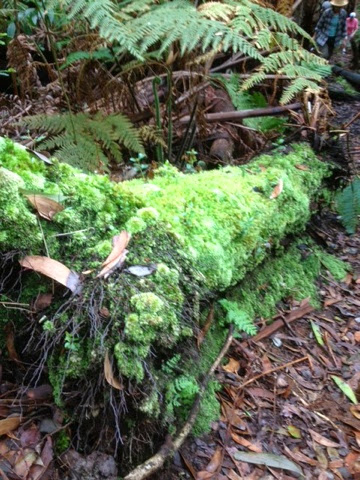
The forest up here is constantly moist. No running streams but everything is wet. 50% of the water comes from rain, but 50% also comes from the fog/clouds that pass through this high forest. The moisture supports the mosses, ferns, and lichens seen everywhere. This fallen tree trunk is covered in green. 
The first tunnel we came upon was Clark tunnel. Tunnels were often named for the foreman of the work crew that built them. Along this particular gorge there are numerous small tunnels. This one has been cleaned out of all the sediment that was blocking it so that it now flows again. It's ready to start capturing water again although for now the water is allowed to naturally flow into the gorge. Within the next few months the pipe will be opened allowing water to travel via the pipe downhill to the coffee mill. 
I came upon many, many ferns thriving in the cool, wet forest. I find them fascinating and beautiful. 
At a resting point, a Nature Conservancy employee talked about the problems that invasive plants cause in a natural watershed, such as the Ka'u Forest Preserve. Hikers also learned about how the forest traps water and transfers it to the stored water below. The forest preseve is a vast nature water storage system. 
The ground in the preserve is wet and muddy once the vegetative overlay is removed. And boy did we find that out! Luckily there were ropes to help steady the hikers and stop their sliding decent if their feet slipped out from under them. I'm happy to report that we didn't lose anyone over a cliff, but many of us ended up with brown butts. 
Sections of aluminum flumes were handy for crosses little ditches. Easier on the knees and kept our feet drier. 
A mile and a half hike in we arrived at Transportation Tunnel. This one is tall and wide enough to easily walk in, plus it's not too long. It cuts through the ridge into the next valley. Although there is. Water transport pipe running through it, there is plenty of water seepage year around. The healthy patch of watercress loves the spot in front of the tunnel. Many of us harvested watercress for our sandwiches. 
The group settled in for a lunch breah in front of Transportation Tunnel where the view through the trees was marvelous. We're fairly high up here so we can look down at our starting spot, the macadamia nut orchards and coffee farms below, the vast lava fields & coastline, the ocean beyond. Al around us we could see and hear plenty of native birds, some quite rare and endangered. It was the first time I've heard many of these birds. 
Needless to say, no picnic tables up here, we collapsed on the grass and munched our lunches in the rain. Not a downpour but we all got soaked. But then, that's what this watershed is all about. 
Before heading back down the trail........the melody of Slip Sliding Away kept creeping into my thoughts..... a few of us took the time to take a closer look at the entrance to Transportation Tunnel. Without boots, we didn't venture too close. But it was pretty neat none the less. 
As we slid our way down the mountain, I had a chance to get close to the pipe at a combination box. I was impressed with the amount of water running through the pipe. And right now they are not harvesting much. Soon they plan to triple or quadruple the amount because then plan calls for a small hydroelectric plant to generate the power needed to run the coffee mill. The discharge water will be used for irrigating the coffee fields. 


Tuesday, May 6, 2014

How I Start a New Day

Donna from Montana asked,"How do I start your day? Do you do something special because you sound so happy. Please tell me how you wake up." 
(Good morning & thank you, papaya tree, for my morning fruit!)

Well Donna, I am basically happy. Oh not all the time about everything. Real life isn't utopia. Of course things go wrong, go not the way I want them to, and outside people interfere with my life. There isn't a day that goes by that doesn't have some sort of either a snag, hassle, problem, disaster. But I try to counteract how the downers in life affect me by setting a good stage in the morning. Doing this took me many decades to learn. I wasn't always good at it. In fact 15 years ago I was in sad shape, mentally, emotionally, physically. One of the many changes I made back then was to try a whole new attitude for starting out my day. 

My daily start-up routine:
...greet the morning. I wake up and first thing tell myself that I had a good sleep, even if I didn't. My inner id doesn't seem to notice the lie and accepts it. I smile to myself. I find that my muscles relax. 
...I then tell myself that it's going to be a good day ahead and that I'm looking forward to it. My inner id seems to accept that lie too, without any questions. 
...the next 15 minutes or so is spent gradually waking up my mind and body. I'll practice some yoga breathing exercises, do yoga stretches. I'll notice each area of my body, flexing and waking it up. I'll tell my inner id how much I enjoy the feel of how each body part is working. Ah, perhaps another lie? 
...next I'll extend my awareness to the world around me. I'll say good morning to the birds, flowers, bees, etc. telling them how good it is to be alive. Ok, maybe lie number 4. Gee, I didn't realize how much of a liar I am! .....and to myself, no less. 
(Good morning little fishes!)
(Good morning, pretty flowers.)
(Good morning, pile of rocks. Perhaps I'll move you today to the end of the new path I'm making.)

...I'll make a mental note of the good things going on in my life at the moment. I'll appreciate the fact that I have enough food, a dry house, a safe place to live. I'll feel happy that I have a partner to go through life with, and some friends and a community. I'll ignore the fact that perhaps there are things not so perfect about those friends, partner, community....at least for now. 
... I'll remind myself that my goal is to enjoy life, explore passion, let the artist in myself out to play, and do things that "I want to do". I was raised as a child to be self-sacrificing, meek, modest. Therefore "being me" is something I had to learn to do as an older adult. 

I find that starting my morning along these lines helps set the stage for the day.

In the evening I also have a winding down routine. Again a few lies to my inner id --- it was a good day all in all.....I got something accomplished that was worthwhile....I felt happiness or joy, at least for part of the day.... I am tired but it is a good tired.....I will sleep a good sleep tonight....I will wake up happy and refreshed. Another little trick for the end of the day....I mentally place each of my problems that are bothering me into an imaginary box, telling myself that they will be safe there until I take them out tomorrow to deal with them again. Then I smile and begin a little yoga to relax my muscles. Goodnight. 

Monday, May 5, 2014

Twigs in the Garden

I've been using twigs in my garden for so long that I don't even give them a thought......at least until today. This afternoon I had a new helper who wants to learn how I grow food. I set him to doing a bit of mulching while I organized things for a quick lesson. When I returned I found that he was done applying the mulch but had gone to the effort of "cleaning up the twigs". He had assumed that they were wind blown twigs and were thus trash to be removed. He had put them into a pile and asked me if they should be thrown into the woods or the trashcan. ....... Neither. They go back into the garden where he found them. 
In nature, leaves, stems, twigs, and even tree branches and trucks fall to the ground where they eventually decompose. Nothing is wasted. Since nature utilizes biomass pretty well, I figure that I can follow nature's example. 

I use just about any shred-able biomass as mulch. Grass. Weeds. Leaves. And I include twigs. The only requirements are that they be small enough in size so as not to interfere with a rototiller, and that they not be a plant variety that will root themselves in my garden. Some of the bushes around here sends out roots fairly readily. 

I break or cut twigs into lengths not more than 6 inches. Then I scatter them lightly in the garden aisleways.  
By putting them in the aisles, they get trod upon causing them to crack and break up even more. Eventually the grass mulch plus twigs ends up as mulch in the vegetable beds, which in turn ends up being rototilled between crops. It's a cycle thing.....
...lay mulch in aisles
...move aisle mulch onto growing veggies as they need more mulch, then replace the aisle mulch with new
...after harvesting veggies, rototill in the old mulch that had been around them.
...plant new crop and when it's ready for mulch, pull the mulch from the aisle onto the veggie bed. 

The reason why I cycle like this is twofold. First, the mulch in the aisles is constantly being walked on. Thus it gets bruised and crushed, resulting in it decomposing easier and faster. Second, I sometimes don't have mulch ready the day that the veggies need it. So grabbing the aisleway mulch is handy and timely. 

So what about those twigs? What benefits? Of course they eventually decompose, becoming soil, becoming nutrition for the garden. But I also notice that they have a bearing on soil moisture retention. Twig treated soil holds moisture better. Plus the soil also doesn't compact as badly nor become "pasty". I don't think that the twigs made the soil significantly better right away. But over the years I can see a real difference between the areas that routinely get twigs and the areas that never have had them added. 

I don't use lots of twigs, not like covering the ground in wood chips. I just use the twigs that I have. And as I said, they get trod on for weeks then get tilled in. I notice that they decompose slower than the grass clippings, but that is just fine. I'm told that woody material is good for soil fungus ecology. That's a plus. 

Sunday, May 4, 2014

Gate Latch Opener

The first time I accidently locked myself inside the dog pen, I was pissed. My hands were too wide to fit through most of the fence openings and zero ones near the gate. I was stuck. Finally had to climb out at one of the pen corners, which wasn't a pretty picture. Thankfully no one was there to video it and post the video up on YouTube. 

I got into the habit of keeping a bent stick wedged in the fence so that I could reach through the mesh and open the latch. But the dogs soon noticed the stick and took to snitching it, chewing into micro pieces. Then a friend gave me the solution.....a wee bit of string. It works perfectly everytime! 
The latch is a standard garden gate latch from a hardware store. It already came with a hole on the latch handle, but if it hadn't, it would be simple to drill one there. I run the string, in this case a piece of electric fence string (which hardly ever breaks), through the hole and around the post that the latch is mounted on. 
From the backside the string looks like this (above photo). 
From a side photo, you can see that the string is run around the post so that it is a bit higher than the latch, maybe 3 inches. 

To use the string to open the closed gate latch from inside the pen, I simply pull up on the string. Wallah! Latch opens and I'm not trapped. 
From the outside you can see that the string pulled the handle up, opening the latch. 
When you let go of the string in normal use, the latch drops back into place. But of course I've already pushed the door open a bit so that I'm not locked in still. 

What a simple solution! 


Saturday, May 3, 2014

Drinking Water

Safe drinking water is not a given in many homes in Hawaii, at least on Big Island. County water infrastructure doesn't reach many housing areas, so residents are on their own. People without county water, or those whose water tap/meter is not on their property, either haul water in or catch rainwater...or both. 

We don't have county water on either of our farms. On the homestead we have three catchment tanks set up to harvest rainwater. If I could get approval for a water meter, it would be installed 0.9 miles from my house. It would be my obligation to run water lines from that meter. Projected cost-- $9,000 to $10,000, perhaps more. And that's if I do the landscaping along the roadside afterwards myself rather than paying someone to do it for me. Yes, I'd have to level the ground, add topsoil cap, and grass seed/fertilizer. 

On the seed farm, we have nothing at the moment. I haul water in. Eventually we will install a catchment tank there for storage of water that we catch, haul in, or buy from a neighbor by sharing a pre-existing line. Running our own water line doesn't seem to be an option since at the moment the county isn't allowing anymore meters in the area. Yes, the government can deny the residents access to the water system here. But running a water line would cost $8000 or more, if we could get permission.

Thus many people are on catchment, and since they are not financially well off, they do not have UV systems for sanitizing the water. The best they can do is add bleach to their tanks and run the water through a filter to eliminate the coarse particles. Some people use that water, others opt to find safer water to use. A local church provides a safe water station for people without street legal cars (cannot haul water from water stations). Happily that community recently got its own water well, making safe water more easily available to its residents.

Using catchment water is fine with us. But we don't have a system that makes the water safe for drinking. Although the bleach we use may be adequate, I'm not certain. That's the case for many people. So the county has water taps where residents can pick up safe water. 
This is the option we choose. This one station pictured above with two taps used to be the sole service for my area, meaning there were often long waits for your turn at a tap. About a year ago the county finally addressed the problem, which people had been complaining about for years. A new water station with five taps was installed at another location, meaning often no waiting lines. By the way, this water is the best tasting water, in my opinion. Really good and worth the effort. 

I happen to pass the water taps five days a week. So I pick up a couple gallons if I pass by and see the station unoccupied. I use plastic milk jugs to get the water to bring home (safer than chancing breaking a glass bottle, which I've manage to do in the past). But at home I transfer it into glass gallon jugs for storage. 
My concern is that chemicals may leach out of the plastic into the water, since the jugs are being reused over and over again. I just feel better storing water in glass. 
For easy use of the water at home, I have a water cooler in the kitchen and a smaller one in the bathroom. Yes, they are plastic, dang! I have my eye out for something glass that I can convert to a water fountain. But until then, I don't put much water into the cooler at a filling so that it doesn't stand there for long periods of time. But using a cooler is safer than pouring water from the glass jugs because we both have "slippery" fingers. We've dropped too many jugs! 

The gallon glass jugs are stored mostly in my kitchen. A keep 4-5 under a shelf for easy access. The rest are stored in the dark. Plus under the house, wrapped in black trash bags, are dozens more glass jugs of "emergency water'. That water has had a bit extra bleach added to it before the jugs were sealed shut. Hopefully I'll never need that water, but you never know. 

Thursday, May 1, 2014

Sunflowers

(All the photos are from Johnny's Seed, where I buy my sunflower seeds)

I mentioned the other day that I've been having problems with sunflowers....lack of pollination. As a result, 50% of the hulls have no seed in them. Duds. Stan from California advised me to don't grow them anymore. He felt that the return wasn't worth the effort. Carol from Connecticutt suggested buying bees to pollinate them. Well, bees are difficult to keep healthy. I have a hive, but it takes time to keep it going. I don't think I want to add more right now. Besides, I figure it costs me around $500 to set up a hive -- two deep brood chambers, two supers, bottom board set up with oil pans and screen, top boards, frames, bees. Pricey solution that I'm not ready to take. Debbie from New Jersey suggested encouraging hummingbirds to visit the farm. I surely miss the little hummingbirds, for they don't exist here in Hawaii. 

So why do I keep growing sunflowers? 

1- For chicken food. 

2- As treats for the sheep and goat. They love the chopped up sunflowers. 

3- Encourages bees to visit the garden area. 

4- And foremost, because they are pretty. I love flowers. They make me smile and make me happy. Even if I never got even one seed from them I'd still have sunflowers growing here. They're great. 
My sunflowers don't often look as nice as these photos from the seed catalog. We have a significant problem with mildew here making the plant look poorly. But the flowers themselves often look nice. 


Tylenol Warning

I saw this article warning and I believe it's serious and important enough to get the message out. Even if spreading the word saves one person, then the effort has been worth it. Us gardening and farming types tend to hit the painkillers from time to time to get relief from aching muscles. But as this article points out, overdosing can cause liver damage, even total failure. Even doctors, pharmacists, dentists and retail stores may not be aware of the problem. So take heed and protect yourself. I'd like you all to be around to share the blog. Here's the link.........